
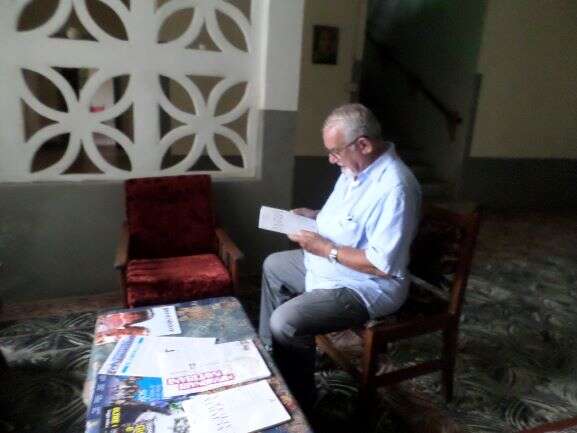
FR. LUIGI BRIONI
One hundred years ago this year we Xaverians of all ages and places have received from our Founder the approved Constitutions of our specific missionary vocation, to proclaim God’s Kingdom to the whole world, ad gentes, ad extra, ad vitam. By professing our four vows of obedience, poverty, chastity and mission, we all have accepted this gift from the Lord, and took the permanent decision to be holy by following the missionary proposal of Guido Maria Conforti.
As Xaverians we dare recognize Conforti as our fundamental mediator of faith, for his experience of God’s holiness has become effective also in our lives, no matter the circumstances in which we were called to embrace this personal covenant of ours with the Lord.
When and where and how was this charism of ours born in Conforti’s life? From his very writings and the memories of his closest friends, we can easily deduct that Conforti deeply felt the vocation to found an institute for the foreign missions towards the end of his philosophy studies, that is when he was about 18 years. We will probably never know what exactly prompted him to fully embrace this “audace progetto” (bold project), but his deep spirituality from the Crucifix and the reading of Saint Francis Xavier’s biography must have been at the very root of his vocation. Certainly, the salvation of souls, as missions were generally understood in those days, was the focus of his deepest desires.
That our Founder could not realize his missionary vocation himself mainly because of poor health does not suggest any bargain with the Lord, but confirmed his determination to give his whole life for the missions in the ways the Lord would certainly suggest him.
And so, his project became a physical and public reality on December 3rd, 1895, with the blessing of the Parma Bishop and with a few seminarians, who actually were more in need of food and shelter than a missionary vocation. But, by placing his project totally in the hands of the crucified Lord, Conforti was not discouraged by the persistent difficulties surrounding him, both at the beginning of the Foundation and till the very end. Nothing could stop his efforts, for he knew that his project was only inspired by the Lord, that only the Lord would have the last word, and that he was only an instrument of God’s will to the ends of the world.
At the beginning of his missionary project Conforti did not plan for his seminarians the vows of a religious congregation, but upon the inspired and explicit suggestion of his bishop Magani, two years after opening his missionary seminary, Conforti immediately and enthusiastically embraced the great benefits of the consecrated life for his sons. (Bertazza 50). Actually, in 1898, his first two sons, Fr. Cajo Rastelli and deacon Odoardo Manini, left Parma for China only after having professed their religious vows for two years. Our Founder felt so blessed with the new development, that he would never change what he considered the fundamental identity of his Institute, three religious vows and one missionary. He was so deeply convinced that religious vows were best for his missionaries, that he himself in 1902 took the religious vows on the very day of his episcopal ordination in the Basilica of Saint Paul in Rome! Later he could not summarize the Xaverian charism better than to emphatically write that, “The apostolic life, combined with the profession of the religious vows, is in itself the most perfect life possible according to the Gospel.” (Testament Letter 2)
Some of his friends and even the Vatican tried to persuade Conforti to establish a missionary society without religious vows as late as 1917, the reason being that, first, its members would be freer in their apostolic activities without being tied to community rules and restrictions, and secondly, they would be under the immediate authority of Propaganda Fide without any interference from the Congregation for Religious (Bertazza 74). But Conforti was so adamant in this that he was even ready to abandon his project all together, if his Institution were not approved with religious vows. Over the years he became ever more convinced that religious life was an integral best of the apostolic life, for which the very first Apostles had left everything and forever.
We all know that one of the main stumbling blocks to keep his charism alive and effective was the formulation of its Constitutions, that is the document/agreement clearly identifying the Xaverian Society and its Members. Rome could not officially approve the Pia Società di San Francesco Saverio per le Missioni Estere without Constitutions being in harmony with the newly published Canon Law of 1917. Those were days when the Church’s Congregations in Rome were strictly structured on fixed rules, and they could hardly budge even to the inspirations of a holy founder. All new religious foundations had to strictly follow the canon laws and Vatican’s directives to be definitely recognized, thus however stifling the spiritual originality of Founders and of their charisma.
Conforti, by no means a canon lawyer, was relying for the formation of his future missionaries more with the Spirit than with the law. But so were the times, and he had to submit his Constitutions according to Rome’s requests and frameworks. Practically for five years, from 1916 to 1921, Conforti wrote and rewrote his Constitutions several times with drafts that Rome often sent back to him for texts to be more legally acceptable. A less patient and humble person than he would have given up, exhausted and annoyed, in a couple of years. However, in his letter to Bishop Calza in China, the Founder wrote: “Rome never denies its nature … it is the city eternal, thus there is need of patience for us to wait some time more.”
Finally, in November 1920, Rome had accepted the Conforti’s texts with minor corrections; and, on January 6th, 1921, the Solemnity of the Epiphany, Bishop Conforti had a private audience with Pope Benedict XV, who had explicitly desired that the approval of the Xaverian Constitutions be dated on that day, “so very meaningful for an exclusively missionary society.” (Bertazza, 80) The long iter of our Constitutions had finally come to its good end leaving us to admire both the patience and perseverance of the Founder, and his paternal love for his missionaries.
Though Conforti’s charismatic inspirations could not be allowed by Rome to shape his Constitutions, they eventually found their providential way in the Testament Letter, which remains for all of us his sons, even today, a hundred years later, the clearest summary of our Founder’s holiness and mission, one of the great treasures of our Xaverian life. There we find our clearest identity, challenge, support … together with his love and prayer, always and everywhere. The Testament Letter is our Xaverian cornerstone, our timeless Gospel.
Conforti does not say that to be a missionary one needs to be religious, but that those who are consecrated with vows are a more faithful image of the Apostles, who left everything for the sake of the Kingdom and its universal mission. Moreover, it was the Apostles who first promoted Christian communities, where the believers were one heart and mind (Acts 4:32) and were totally available for the spreading of the Gospel everywhere. Conforti understood very well for himself and his missionaries that the apostolic life expressed itself best drawing life from Jesus, as the branches from the vine (Jo 15:5). Though Conforti could not make it to the mission as he had ardently desired, he lived this apostolic vocation to the very best of his person, in full union with Christ, submitting everything he was and had to his audacious project. And how happy he was when he received from his missionaries their good news of many conversions and baptisms!
One hundred and twenty-five year ago the world of Conforti was very different from ours today. Life expectancy, globalization, instant communications, etc., but the basic premises for our faith and apostolic vocation have not changed, actually they may have become even more evident. We are fully Xaverian today with the charism of our Founder and his blessed intercession. When Conforti qualified his missionary spirituality and that of his missionaries with the religious vows, he clearly emphasized the total gift of ourselves to God as the best premise of a fruitful apostolic life. His charism was truly a passion for both Christ and humanity. And it remains so even today, in each one of us!
In the famous number 10 paragraph of his Testament Letter, Conforti summarizes well, first for himself and for all of us, his last generation, the essential traits of the Xaverian vocation: “… a spirit of living faith which enables us to see God, seek God, love God in all things, intensifying our desire to spread his kingdom everywhere; a spirit of prompt and ready obedience in everything, no matter how costly, … a spirit of intense love for our religious family, that we must look upon as a mother, and a spirit of intense love for all the members of our Society. This is my wish, and I ask you to accept it as a father’s final will.” Very a few founders could express this more meaningfully!
I personally disagree with some Xaverians, mostly of the old days, who were saying that Conforti was “a normal” person and bishop. How could he be “normal” with the holiness and wholeness of all his life? With his constant and extraordinary desire for personal holiness and the “salvation of souls”, with his suffering charity to all, his inspired sermons and letters, his efforts to mediate Christ’s peace to all and everywhere, his full pastoral attention both to the local and universal church, his judgement balance, his unshakable faith in God’s providence, his deep humility to resign from Ravenna’s episcopal see and bear the offenses of his Xaverians from China … all this and more, much more, does it really make Conforti a normal one among us? Even today, after so many years, we ourselves can feel the powerful and living inspiration of his words and his holiness, the certainty of his project and foundation, the universal availability of his charism for all ages and places. For each one of us. Yes, he may not be easily imitable, but he remains a reliable guide for our vocation and, actually, for our very life.
At Conforti’s funeral in Parma, bishop Giovanni Cazzani of my Cremona diocese could summarize the holiness of our Founder with much ease, because it had already become the evident treasure of his diocese, of his missionary family, and of the whole world.
The deepest root of Conforti’s holiness was the contemplation of the obedient Christ, crucified and totally sacrificed on the altar of love. Our Founder truly and fully lived within himself Christ’s passion and love with extraordinary holiness. The words of some women of Parma after his death perfectly expressed the holiness of Conforti, when they were recorded to say, “The Lord could not have been a better person than him!” (Al Signeur al podeva mia essar pusè bon ad lo).
In March 1894 we have the first public document of Conforti’s missionary project in his letter to Card. Lodokowski, then the head of the Congregation of Propaganda Fide. In it there is no mention of religious life as essential to the new missionary seminary. The only purpose of the Institute was definitely “the Propagation of the Catholic religion among the pagans.”
On the very birthday of the Institution, December 3rd, 1895, Conforti wrote again a letter full of hopes to the cardinal of Propaganda of Fide. There his enthusiasm for the missions was passionately clear. “May the dawn of that fortunate day come soon, when our first missionaries, desirous of martyrdom and the spreading of the Gospel can be made available to your Sacred Congregation.”
The missionary zeal of the Founder would embrace the whole world even though the realities of his project were quite limited. On that day he could count only on some 20 young boys together with Fr. Cajo Rastelli, but they all stood ready for a totally new Christian vocation, that of missionary life.
On December 3rd, 1898, the diocesan approval of the Institute as a religious congregation in the diocese of Parma was made public, to the great joy of Conforti and his Xaverian seminary. The Founder had given to his Seminary its only purpose, “that is the preaching of the Gospel in pagan lands according to the mandate of Christ to his Apostles … excluding any other purpose even if noble and holy.”
In that short time of three years Conforti became totally convinced that his Institute could not exist without becoming a religious Congregation, with the religious vows as an integral part of its missionary charism.
To the Rome’s objections that the Conforti’s Institute did not need religious vows to be missionary, he kindly but adamantly wrote back to them later in 1916: “I feel that the detachment from everything on this earth and the total and irrevocable sacrifice for the greatest and holiest of all causes can better contribute to its triumph (Volta, 147)”. We all remember the Founder to be a gentle and soft person with people of all kinds, but, when he came to defend his project, nothing and nobody could change his inspiration and determination. Nothing, not even Rome.
Conforti earnestly put himself at work to review his Constitutions, but he was hardly prepared for the task. The new canon law had just been promulgated, and he had to adapt his Constitutions to its strict laws and directives. Eventually he finished his work in the year 1920, with its final approval from Rome signed on January 6th, 1921, the Feast of the Epiphany.
On July 2nd 1921, presenting the printed Constitutions to his children in China, he wrote, “As I invite you to rejoice and thank the Lord for the holiness and opportunity of the Institution to which we have given our name, I remind you to keep your attention on the serious and solemn commitment we have come to accept with both God and his Church.” (Volta, 149).
In the words of Fr. Volta, “Conforti had won then the greatest peaceful battle of his life.” (149)
From Rome’s approval to the Founder’s death ten years later, our Congregation became mature and its identity clear, that it is of a Society both religious and missionary. It was the genius of Conforti to unite the religious vows to the missionary activities without clashes. Again, in the words of Fr. Volta, “the two realities were fused with his intelligent charity.” (152)
Of great interest is that in the formation of his novices and those already professed Conforti was very attentive to save the unique personality of everyone, even in their smallest expressions. Thus, most of the practices of piety for the Xaverians were left to the individual’s responsibility. Morning prayers were recited while getting dressed; meditation done at their personal desk; ... the rosary walking on the corridors; and finally the night prayers by themselves. …. There was no need to pray by kneeling down! (154). All this because Conforti was well aware that his missionaries had to be on the road to evangelize, and, moreover, to live by themselves most of the time. That’s why his insistence on personal spiritual formation and responsibility.
At the same time Conforti also insisted that his sons tried to live in small communities, “to better conserve in everyone the religious and apostolic spirit and to facilitate the practices of religious life. (As in the Xaverian General Chapter of 1929)
In the words of Fr. Volta, who experienced the Founder’s formation in those days at the Mother House, “Everyone was given a personal responsibility, and the community was an organism made up of responsible members. This was the original and genial aspect of the Institute by the Founder.”
In China too the Xaverians, formed by Conforti, made an impression of religious communion and apostolic zeal even among older and experienced missionaries. Haft jokingly the Xaverians were often referred to as “la società del mutuo incensamento (the society where there was mutual incensation).”
From 1921 to 1931 our Xaverian Congregation becomes of age and well identified both in Italy and in China. Some Confreres would continue to discuss for years which one came first, the religious vows or the mission; but there was no doubt in Conforti that his sons were integrally religious and missionary, in the totality of their vocation.
Bishop Conforti in one of his sharings said that perfection is not something that happens now and then, but the stable continuity of doing good. He himself lived this way together with interior wholeness and harmony. For him everything was an occasion of grace. (Volta, 166) Fr. Volta would recognize that Conforti’s adventure of holiness was qualified by unity in multiplicity. In him there was always a profound sense of peace, that peace which could come only from the Lord himself. (168)
Our Founder would not be remembered so much for miraculous deeds like other saints, but miracles he did work with his inner peace, like the successful reconciliation among his clergy, the loving acceptance by many people hostile to the Church, and the success of his Institute mainly supported with the means of divine Providence.
One of his usual expressions was, Trust in Providence, not in a superficial way, but because he was radically convinced to see God, seek God, love God in everything. In that “everything” Conforti could be sure that particular things would turn out to be OK, no matter the difficulties and delays. Thus one day he could confide to his friends that: “La Provvidenza non mi ha mai fatto fare brutta figura”. (Providence had never given me a bad face.) 169
On his death bed in 1931, our Founder could certainly have repeated the conclusion of his Testament Letter of 1921, that « as I feel the love of Christ in all its fullness, a love by far superior to any natural affection, and I see clearly the greatness of the cause that unites us in a single family, I warmly embrace the present and future members of our Society, as if they were here present. Unworthy though I am, I ask the Lord to grant everyone the spirit of the Apostles and the gift of final perseverance. In the hope that we will one day meet together in heaven, and share the same heavenly home land, after having been members of the same family on earth, I bless you all. “ (11)
One hundred years ago this year we Xaverians of all ages and places have received from our Founder the approved Constitutions of our specific missionary vocation, to proclaim God’s Kingdom to the whole world, ad gentes, ad extra, ad vitam. By professing our four vows of obedience, poverty, chastity and mission, we all have accepted this gift from the Lord, and took the permanent decision to be holy by following the missionary proposal of Guido Maria Conforti.
As Xaverians we dare recognize Conforti as our fundamental mediator of faith, for his experience of God’s holiness has become effective also in our lives, no matter the circumstances in which we were called to embrace this personal covenant of ours with the Lord.
When and where and how was this charism of ours born in Conforti’s life? From his very writings and the memories of his closest friends, we can easily deduct that Conforti deeply felt the vocation to found an institute for the foreign missions towards the end of his philosophy studies, that is when he was about 18 years. We will probably never know what exactly prompted him to fully embrace this “audace progetto” (bold project), but his deep spirituality from the Crucifix and the reading of Saint Francis Xavier’s biography must have been at the very root of his vocation. Certainly, the salvation of souls, as missions were generally understood in those days, was the focus of his deepest desires.
That our Founder could not realize his missionary vocation himself mainly because of poor health does not suggest any bargain with the Lord, but confirmed his determination to give his whole life for the missions in the ways the Lord would certainly suggest him.
And so, his project became a physical and public reality on December 3rd, 1895, with the blessing of the Parma Bishop and with a few seminarians, who actually were more in need of food and shelter than a missionary vocation. But, by placing his project totally in the hands of the crucified Lord, Conforti was not discouraged by the persistent difficulties surrounding him, both at the beginning of the Foundation and till the very end. Nothing could stop his efforts, for he knew that his project was only inspired by the Lord, that only the Lord would have the last word, and that he was only an instrument of God’s will to the ends of the world.
At the beginning of his missionary project Conforti did not plan for his seminarians the vows of a religious congregation, but upon the inspired and explicit suggestion of his bishop Magani, two years after opening his missionary seminary, Conforti immediately and enthusiastically embraced the great benefits of the consecrated life for his sons. (Bertazza 50). Actually, in 1898, his first two sons, Fr. Cajo Rastelli and deacon Odoardo Manini, left Parma for China only after having professed their religious vows for two years. Our Founder felt so blessed with the new development, that he would never change what he considered the fundamental identity of his Institute, three religious vows and one missionary. He was so deeply convinced that religious vows were best for his missionaries, that he himself in 1902 took the religious vows on the very day of his episcopal ordination in the Basilica of Saint Paul in Rome! Later he could not summarize the Xaverian charism better than to emphatically write that, “The apostolic life, combined with the profession of the religious vows, is in itself the most perfect life possible according to the Gospel.” (Testament Letter 2)
Some of his friends and even the Vatican tried to persuade Conforti to establish a missionary society without religious vows as late as 1917, the reason being that, first, its members would be freer in their apostolic activities without being tied to community rules and restrictions, and secondly, they would be under the immediate authority of Propaganda Fide without any interference from the Congregation for Religious (Bertazza 74). But Conforti was so adamant in this that he was even ready to abandon his project all together, if his Institution were not approved with religious vows. Over the years he became ever more convinced that religious life was an integral best of the apostolic life, for which the very first Apostles had left everything and forever.
We all know that one of the main stumbling blocks to keep his charism alive and effective was the formulation of its Constitutions, that is the document/agreement clearly identifying the Xaverian Society and its Members. Rome could not officially approve the Pia Società di San Francesco Saverio per le Missioni Estere without Constitutions being in harmony with the newly published Canon Law of 1917. Those were days when the Church’s Congregations in Rome were strictly structured on fixed rules, and they could hardly budge even to the inspirations of a holy founder. All new religious foundations had to strictly follow the canon laws and Vatican’s directives to be definitely recognized, thus however stifling the spiritual originality of Founders and of their charisma.
Conforti, by no means a canon lawyer, was relying for the formation of his future missionaries more with the Spirit than with the law. But so were the times, and he had to submit his Constitutions according to Rome’s requests and frameworks. Practically for five years, from 1916 to 1921, Conforti wrote and rewrote his Constitutions several times with drafts that Rome often sent back to him for texts to be more legally acceptable. A less patient and humble person than he would have given up, exhausted and annoyed, in a couple of years. However, in his letter to Bishop Calza in China, the Founder wrote: “Rome never denies its nature … it is the city eternal, thus there is need of patience for us to wait some time more.”
Finally, in November 1920, Rome had accepted the Conforti’s texts with minor corrections; and, on January 6th, 1921, the Solemnity of the Epiphany, Bishop Conforti had a private audience with Pope Benedict XV, who had explicitly desired that the approval of the Xaverian Constitutions be dated on that day, “so very meaningful for an exclusively missionary society.” (Bertazza, 80) The long iter of our Constitutions had finally come to its good end leaving us to admire both the patience and perseverance of the Founder, and his paternal love for his missionaries.
Though Conforti’s charismatic inspirations could not be allowed by Rome to shape his Constitutions, they eventually found their providential way in the Testament Letter, which remains for all of us his sons, even today, a hundred years later, the clearest summary of our Founder’s holiness and mission, one of the great treasures of our Xaverian life. There we find our clearest identity, challenge, support … together with his love and prayer, always and everywhere. The Testament Letter is our Xaverian cornerstone, our timeless Gospel.
Conforti does not say that to be a missionary one needs to be religious, but that those who are consecrated with vows are a more faithful image of the Apostles, who left everything for the sake of the Kingdom and its universal mission. Moreover, it was the Apostles who first promoted Christian communities, where the believers were one heart and mind (Acts 4:32) and were totally available for the spreading of the Gospel everywhere. Conforti understood very well for himself and his missionaries that the apostolic life expressed itself best drawing life from Jesus, as the branches from the vine (Jo 15:5). Though Conforti could not make it to the mission as he had ardently desired, he lived this apostolic vocation to the very best of his person, in full union with Christ, submitting everything he was and had to his audacious project. And how happy he was when he received from his missionaries their good news of many conversions and baptisms!
One hundred and twenty-five year ago the world of Conforti was very different from ours today. Life expectancy, globalization, instant communications, etc., but the basic premises for our faith and apostolic vocation have not changed, actually they may have become even more evident. We are fully Xaverian today with the charism of our Founder and his blessed intercession. When Conforti qualified his missionary spirituality and that of his missionaries with the religious vows, he clearly emphasized the total gift of ourselves to God as the best premise of a fruitful apostolic life. His charism was truly a passion for both Christ and humanity. And it remains so even today, in each one of us!
In the famous number 10 paragraph of his Testament Letter, Conforti summarizes well, first for himself and for all of us, his last generation, the essential traits of the Xaverian vocation: “… a spirit of living faith which enables us to see God, seek God, love God in all things, intensifying our desire to spread his kingdom everywhere; a spirit of prompt and ready obedience in everything, no matter how costly, … a spirit of intense love for our religious family, that we must look upon as a mother, and a spirit of intense love for all the members of our Society. This is my wish, and I ask you to accept it as a father’s final will.” Very a few founders could express this more meaningfully!
I personally disagree with some Xaverians, mostly of the old days, who were saying that Conforti was “a normal” person and bishop. How could he be “normal” with the holiness and wholeness of all his life? With his constant and extraordinary desire for personal holiness and the “salvation of souls”, with his suffering charity to all, his inspired sermons and letters, his efforts to mediate Christ’s peace to all and everywhere, his full pastoral attention both to the local and universal church, his judgement balance, his unshakable faith in God’s providence, his deep humility to resign from Ravenna’s episcopal see and bear the offenses of his Xaverians from China … all this and more, much more, does it really make Conforti a normal one among us? Even today, after so many years, we ourselves can feel the powerful and living inspiration of his words and his holiness, the certainty of his project and foundation, the universal availability of his charism for all ages and places. For each one of us. Yes, he may not be easily imitable, but he remains a reliable guide for our vocation and, actually, for our very life.
At Conforti’s funeral in Parma, bishop Giovanni Cazzani of my Cremona diocese could summarize the holiness of our Founder with much ease, because it had already become the evident treasure of his diocese, of his missionary family, and of the whole world.
The deepest root of Conforti’s holiness was the contemplation of the obedient Christ, crucified and totally sacrificed on the altar of love. Our Founder truly and fully lived within himself Christ’s passion and love with extraordinary holiness. The words of some women of Parma after his death perfectly expressed the holiness of Conforti, when they were recorded to say, “The Lord could not have been a better person than him!” (Al Signeur al podeva mia essar pusè bon ad lo).
In March 1894 we have the first public document of Conforti’s missionary project in his letter to Card. Lodokowski, then the head of the Congregation of Propaganda Fide. In it there is no mention of religious life as essential to the new missionary seminary. The only purpose of the Institute was definitely “the Propagation of the Catholic religion among the pagans.”
On the very birthday of the Institution, December 3rd, 1895, Conforti wrote again a letter full of hopes to the cardinal of Propaganda of Fide. There his enthusiasm for the missions was passionately clear. “May the dawn of that fortunate day come soon, when our first missionaries, desirous of martyrdom and the spreading of the Gospel can be made available to your Sacred Congregation.”
The missionary zeal of the Founder would embrace the whole world even though the realities of his project were quite limited. On that day he could count only on some 20 young boys together with Fr. Cajo Rastelli, but they all stood ready for a totally new Christian vocation, that of missionary life.
On December 3rd, 1898, the diocesan approval of the Institute as a religious congregation in the diocese of Parma was made public, to the great joy of Conforti and his Xaverian seminary. The Founder had given to his Seminary its only purpose, “that is the preaching of the Gospel in pagan lands according to the mandate of Christ to his Apostles … excluding any other purpose even if noble and holy.”
In that short time of three years Conforti became totally convinced that his Institute could not exist without becoming a religious Congregation, with the religious vows as an integral part of its missionary charism.
To the Rome’s objections that the Conforti’s Institute did not need religious vows to be missionary, he kindly but adamantly wrote back to them later in 1916: “I feel that the detachment from everything on this earth and the total and irrevocable sacrifice for the greatest and holiest of all causes can better contribute to its triumph (Volta, 147)”. We all remember the Founder to be a gentle and soft person with people of all kinds, but, when he came to defend his project, nothing and nobody could change his inspiration and determination. Nothing, not even Rome.
Conforti earnestly put himself at work to review his Constitutions, but he was hardly prepared for the task. The new canon law had just been promulgated, and he had to adapt his Constitutions to its strict laws and directives. Eventually he finished his work in the year 1920, with its final approval from Rome signed on January 6th, 1921, the Feast of the Epiphany.
On July 2nd 1921, presenting the printed Constitutions to his children in China, he wrote, “As I invite you to rejoice and thank the Lord for the holiness and opportunity of the Institution to which we have given our name, I remind you to keep your attention on the serious and solemn commitment we have come to accept with both God and his Church.” (Volta, 149).
In the words of Fr. Volta, “Conforti had won then the greatest peaceful battle of his life.” (149)
From Rome’s approval to the Founder’s death ten years later, our Congregation became mature and its identity clear, that it is of a Society both religious and missionary. It was the genius of Conforti to unite the religious vows to the missionary activities without clashes. Again, in the words of Fr. Volta, “the two realities were fused with his intelligent charity.” (152)
Of great interest is that in the formation of his novices and those already professed Conforti was very attentive to save the unique personality of everyone, even in their smallest expressions. Thus, most of the practices of piety for the Xaverians were left to the individual’s responsibility. Morning prayers were recited while getting dressed; meditation done at their personal desk; ... the rosary walking on the corridors; and finally the night prayers by themselves. …. There was no need to pray by kneeling down! (154). All this because Conforti was well aware that his missionaries had to be on the road to evangelize, and, moreover, to live by themselves most of the time. That’s why his insistence on personal spiritual formation and responsibility.
At the same time Conforti also insisted that his sons tried to live in small communities, “to better conserve in everyone the religious and apostolic spirit and to facilitate the practices of religious life. (As in the Xaverian General Chapter of 1929)
In the words of Fr. Volta, who experienced the Founder’s formation in those days at the Mother House, “Everyone was given a personal responsibility, and the community was an organism made up of responsible members. This was the original and genial aspect of the Institute by the Founder.”
In China too the Xaverians, formed by Conforti, made an impression of religious communion and apostolic zeal even among older and experienced missionaries. Haft jokingly the Xaverians were often referred to as “la società del mutuo incensamento (the society where there was mutual incensation).”
From 1921 to 1931 our Xaverian Congregation becomes of age and well identified both in Italy and in China. Some Confreres would continue to discuss for years which one came first, the religious vows or the mission; but there was no doubt in Conforti that his sons were integrally religious and missionary, in the totality of their vocation.
Bishop Conforti in one of his sharings said that perfection is not something that happens now and then, but the stable continuity of doing good. He himself lived this way together with interior wholeness and harmony. For him everything was an occasion of grace. (Volta, 166) Fr. Volta would recognize that Conforti’s adventure of holiness was qualified by unity in multiplicity. In him there was always a profound sense of peace, that peace which could come only from the Lord himself. (168)
Our Founder would not be remembered so much for miraculous deeds like other saints, but miracles he did work with his inner peace, like the successful reconciliation among his clergy, the loving acceptance by many people hostile to the Church, and the success of his Institute mainly supported with the means of divine Providence.
One of his usual expressions was, Trust in Providence, not in a superficial way, but because he was radically convinced to see God, seek God, love God in everything. In that “everything” Conforti could be sure that particular things would turn out to be OK, no matter the difficulties and delays. Thus one day he could confide to his friends that: “La Provvidenza non mi ha mai fatto fare brutta figura”. (Providence had never given me a bad face.) 169
On his death bed in 1931, our Founder could certainly have repeated the conclusion of his Testament Letter of 1921, that « as I feel the love of Christ in all its fullness, a love by far superior to any natural affection, and I see clearly the greatness of the cause that unites us in a single family, I warmly embrace the present and future members of our Society, as if they were here present. Unworthy though I am, I ask the Lord to grant everyone the spirit of the Apostles and the gift of final perseverance. In the hope that we will one day meet together in heaven, and share the same heavenly home land, after having been members of the same family on earth, I bless you all. “ (11)