
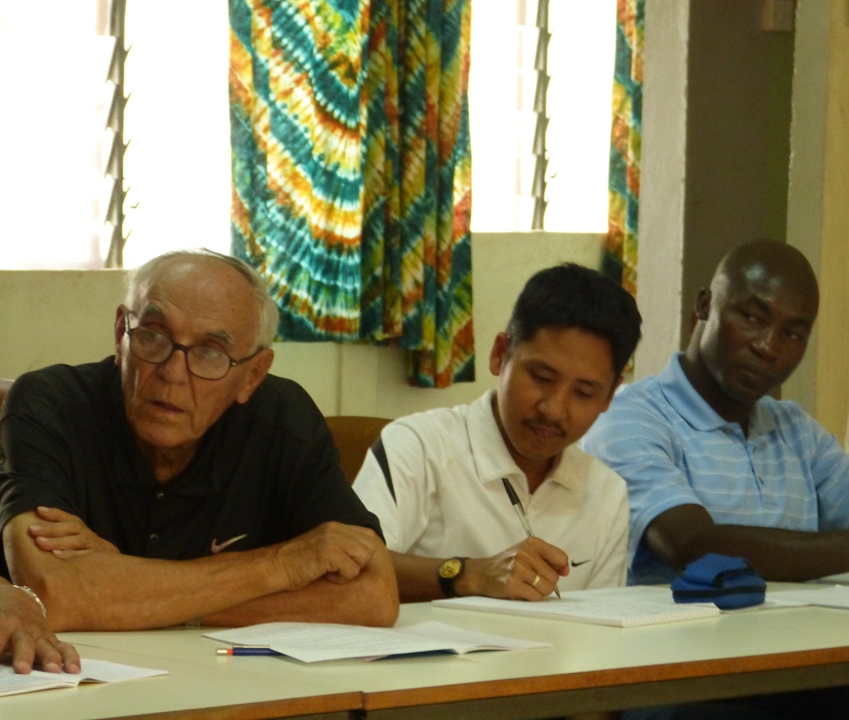
Fr. Martin Ali keke Ndemsou, sx
Language matters in an efficient missionary apostolate. Encountering people, learning their culture, sharing with them our Christian faith, passes through language. This is why, learning a language in a mission should be one of our missionary priorities. Celebrating in a special way Maximum Illud, a missionary Encyclical Letter written by Benedict XV in 1919, invites us to remember what is in it about the importance of language in missionary work. “Among the attainments necessary for the life of a missionary, a place of paramount importance must obviously be granted to the language of the people to whose salvation he will devote himself. He should not be content with smattering of the language, but should be able to speak it readily and competently.”(Benedict XV, Maximum Illud, 1919, n°24). I would like to share my experience in learning new languages in a mission with you in two parts: what helps me to keep on learning Limba although it is not a walk in the park and my inspirators.
- My experience in Leaning New Languages in Sierra Leone
Learning a new language requires humility. Without this virtue, it would be difficult to learn a new language. It is easier to teach others a language that we master than to learn from them. After having completed my basic formation in theology in Yaoundé (Cameroon), our Direction General assigned me to Sierra Leone. Therefore, I had to learn English which is an official language in that country because I am from Chad which is a French speaking country.
After my priestly ordination, I was sent to the USA to learn English. There, I had to buckle down to learn it in one year. It has been a nice experience of humility for me because I had to accept my ignorance, my mistakes in order to learn it for the sake of the spreading of the Good News.
When I arrived in Sierra Leone, I realized that I had to learn Krio too. In fact, it is widely spoken in Sierra Leonean main towns. I learnt it as quickly as possible in order to have a great acquaintance with people. This is what our Fundamental Rule (n°16) recommends as well: “The missionary should take special care, right from the beginning, to learn and speak the local language fluently as quickly as possible.”
Then my Regional Superior at that time (2015) assigned me to Saints Peter and Paul Parish in Fadugu where almost 99% of our parishioners are Limba people. That is why I decided to learn this local language as well. It is a beautiful but challenging experience. I will not give up learning it. For besides humility, perseverance is a virtue that should be cultivate while learning a language in a mission.
In addition, two things help me to keep on learning Limba language. First, what Nelson Mandela said: “If you talk to a man in a language he understands, that goes to his head. If you talk to him in his language, that goes to his heart” (cf. www. bbc. uk). This is my wish; I would like the Word of God I share with them goes not only to their heads, but also and mostly to their hearts and brings conversion. Secondly, they are happy when I use simple words I learnt from them. For example: nthoro equivalent of osh in Krio to express my sympathy with someone who is suffering. Or Nama na kotoko which means how are you? This makes me feel part of them.
- My models in Learning a language in a mission
In the Church, there are many people who can be considered as models regarding learning new languages in order to spread the Good News. They are saints, missionaries among which our confreres. I know that some our confreres learnt very well languages such as Swahili, Lingala, and even Chinese to name but a few. Among them, I selected saints Cyril and Methodius, our confreres in Chad and some of our pioneers in Sierra Leone as models.
Saints Cyril and Mathodius
They are regarded as slovonic fathers because they not only mastered this local language, but also translated the bible and the liturgy in the same language. They can be taken as models of learning a language in a mission. Although their initiative was criticized, they did not give up. Later, Pope Nicholas confirmed their missionary endeavors and made them bishops. Their example must be recalled and imitated as we are celebrating the centenary of Maximum Illud which invites us to learn the language of people to whom we are sent on mission (cf.https://www.encyclopedia.com/people/philosophy-and-religion/saints/saints-cyril-and-methodius).
Our Confreres in Chad
Our confreres in Chad are models for me in learning local language. They learnt well Musey language which is widely spoken where they are. They even translated the New Testament in Musey. Most of them preach directly in Musey. This should be done in Sierra Leone too.
Some of our Pioneers in Sierra Leone
Some of our confreres did very well in learning Limba language and culture: Fathers Rabito, Tony and Franco. They are great examples for us. Usually when I try to speak Limba in the villages they compare me to them saying: “Father Martin you are like your brothers fathers Rabito, Tony and Franco. They loved our culture and learnt our language.” I am very proud to be compared with them mostly with late father Rabito who is remembered as being the missionary of Limba people.
Learning a new language in a mission is worth. It helps the missionary to be in a position of listening to people to whom he is sent. Being taught, the missionary becomes humble. It is another way of imitating Jesus Christ, the missionary par excellence who became humbler “even to accepting death, death on a cross” (Ph 2: 8). Also, it requires perseverance because it is an everyday commitment.
Language matters in an efficient missionary apostolate. Encountering people, learning their culture, sharing with them our Christian faith, passes through language. This is why, learning a language in a mission should be one of our missionary priorities. Celebrating in a special way Maximum Illud, a missionary Encyclical Letter written by Benedict XV in 1919, invites us to remember what is in it about the importance of language in missionary work. “Among the attainments necessary for the life of a missionary, a place of paramount importance must obviously be granted to the language of the people to whose salvation he will devote himself. He should not be content with smattering of the language, but should be able to speak it readily and competently.”(Benedict XV, Maximum Illud, 1919, n°24). I would like to share my experience in learning new languages in a mission with you in two parts: what helps me to keep on learning Limba although it is not a walk in the park and my inspirators.
- My experience in Leaning New Languages in Sierra Leone
Learning a new language requires humility. Without this virtue, it would be difficult to learn a new language. It is easier to teach others a language that we master than to learn from them. After having completed my basic formation in theology in Yaoundé (Cameroon), our Direction General assigned me to Sierra Leone. Therefore, I had to learn English which is an official language in that country because I am from Chad which is a French speaking country.
After my priestly ordination, I was sent to the USA to learn English. There, I had to buckle down to learn it in one year. It has been a nice experience of humility for me because I had to accept my ignorance, my mistakes in order to learn it for the sake of the spreading of the Good News.
When I arrived in Sierra Leone, I realized that I had to learn Krio too. In fact, it is widely spoken in Sierra Leonean main towns. I learnt it as quickly as possible in order to have a great acquaintance with people. This is what our Fundamental Rule (n°16) recommends as well: “The missionary should take special care, right from the beginning, to learn and speak the local language fluently as quickly as possible.”
Then my Regional Superior at that time (2015) assigned me to Saints Peter and Paul Parish in Fadugu where almost 99% of our parishioners are Limba people. That is why I decided to learn this local language as well. It is a beautiful but challenging experience. I will not give up learning it. For besides humility, perseverance is a virtue that should be cultivate while learning a language in a mission.
In addition, two things help me to keep on learning Limba language. First, what Nelson Mandela said: “If you talk to a man in a language he understands, that goes to his head. If you talk to him in his language, that goes to his heart” (cf. www. bbc. uk). This is my wish; I would like the Word of God I share with them goes not only to their heads, but also and mostly to their hearts and brings conversion. Secondly, they are happy when I use simple words I learnt from them. For example: nthoro equivalent of osh in Krio to express my sympathy with someone who is suffering. Or Nama na kotoko which means how are you? This makes me feel part of them.
- My models in Learning a language in a mission
In the Church, there are many people who can be considered as models regarding learning new languages in order to spread the Good News. They are saints, missionaries among which our confreres. I know that some our confreres learnt very well languages such as Swahili, Lingala, and even Chinese to name but a few. Among them, I selected saints Cyril and Methodius, our confreres in Chad and some of our pioneers in Sierra Leone as models.
Saints Cyril and Mathodius
They are regarded as slovonic fathers because they not only mastered this local language, but also translated the bible and the liturgy in the same language. They can be taken as models of learning a language in a mission. Although their initiative was criticized, they did not give up. Later, Pope Nicholas confirmed their missionary endeavors and made them bishops. Their example must be recalled and imitated as we are celebrating the centenary of Maximum Illud which invites us to learn the language of people to whom we are sent on mission (cf.https://www.encyclopedia.com/people/philosophy-and-religion/saints/saints-cyril-and-methodius).
Our Confreres in Chad
Our confreres in Chad are models for me in learning local language. They learnt well Musey language which is widely spoken where they are. They even translated the New Testament in Musey. Most of them preach directly in Musey. This should be done in Sierra Leone too.
Some of our Pioneers in Sierra Leone
Some of our confreres did very well in learning Limba language and culture: Fathers Rabito, Tony and Franco. They are great examples for us. Usually when I try to speak Limba in the villages they compare me to them saying: “Father Martin you are like your brothers fathers Rabito, Tony and Franco. They loved our culture and learnt our language.” I am very proud to be compared with them mostly with late father Rabito who is remembered as being the missionary of Limba people.
Learning a new language in a mission is worth. It helps the missionary to be in a position of listening to people to whom he is sent. Being taught, the missionary becomes humble. It is another way of imitating Jesus Christ, the missionary par excellence who became humbler “even to accepting death, death on a cross” (Ph 2: 8). Also, it requires perseverance because it is an everyday commitment.