
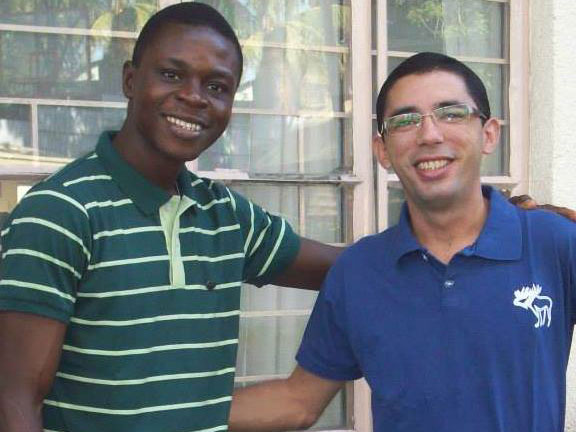
Patrick Fornah, s.x.
I wish to start with words of praise and gratitude in sharing my impression and experience in the Philippines. I arrived in the Philippines on the September 7, 2014. I had my first missionary experience at the Manila airport, where I had to recite the canticle of Zachariah and the Magnificat, to prove my missionary and christian identity. After that simple test of faith, I received a great welcome from my confreres, who had long awaited my arrival. They greeted me with the tagalog word “Mabuhay” which means: Welcome! May you live long! Let there be life! We are happy to see you!
However, seven months have already passed since my arrival; I still hear that first word that I heard “Mabuhay”; and I continue to remember and enjoy the first night with my brothers. Then, I still hear the Horn of the crosswind Vehicle that brought me from the airport. Moreover, I still feel the hugs and fraternal embraces from my confreres. Besides, I feel the taste of the first dinner; and I feel the spiritual atmosphere of the first Lauds and Eucharist. Above all, I still hear and feel the welcome greetings of the seven nationalities represented in the community (Philippines, Indonesia, Brazil, Mexico, Burundi, Congo and Cameroon).
Eventually, the fraternal welcome of my brothers introduced me to the basic reality of being a missionary in the Philippines, which is to study the Filipino language and culture. I studied the formal tagalog for four months and began to practise it with the people. During my studies and practice, I discovered some of the important aspects and richness of the language. First I discovered that the Tagalog language is broad and rich in its meaning. Each word has its own defined meaning and explanation. Secondly it is amalgamated with local dialects and other languages such as Cebuano, Visayas and Spanish. Then, there is the formal tagalog, which is used in schools and formal settings; and informal tagalog which is used in daily conversation.
My impression about the formal tagalog which I learnt in class is that it is not sufficient for the missionary apostolate and relations with the people. Hence, I still feel my limitation when sharing the Christian message with the youth and children. In view of this limitation, I think that patience and attentive listening is demanded of me to enter into the native rhythm of the language. Therefore I wish to express my gratitude to all the youth (mga Kabataan) and children (mga Bata), who have helped me to understand and speak the basic tagalog. Above all, my sincere gratitude to Ate Bien, who has been my mentor since the beginning of my tagalog journey and who has helped me greatly to memorize and pronounce words correctly.
In my experience with the people, my most profound appreciation goes to the values, virtues and faith expressions, which I found among the poor Filipino People. The people are so simple, humble and ready to smile. Their smiling comes so natural. Even in difficult moments, they still smile. They are generous and hospitable. Even though some are poor, they are always willing and ready to share their faith, food and shelter. For instance, during the Saturday and Sunday apostolate, we use small rooms offered by poor people to meditate on the word of God.
Before concluding my sharing, I wish to mention that the peak experience is the encounter with the Lord in faith expressions, devotions and celebrations, such as the “Simbang Gabi”, Holy week and “salubong”, which is the top Easter celebration in the Philippines. Last of all, my words cannot fully express all my experiences and impressions. Nevertheless, may I say that I am motivated and inspired by all the christian expressions of faith and charity in the Philippines.
I wish to start with words of praise and gratitude in sharing my impression and experience in the Philippines. I arrived in the Philippines on the September 7, 2014. I had my first missionary experience at the Manila airport, where I had to recite the canticle of Zachariah and the Magnificat, to prove my missionary and christian identity. After that simple test of faith, I received a great welcome from my confreres, who had long awaited my arrival. They greeted me with the tagalog word “Mabuhay” which means: Welcome! May you live long! Let there be life! We are happy to see you!
However, seven months have already passed since my arrival; I still hear that first word that I heard “Mabuhay”; and I continue to remember and enjoy the first night with my brothers. Then, I still hear the Horn of the crosswind Vehicle that brought me from the airport. Moreover, I still feel the hugs and fraternal embraces from my confreres. Besides, I feel the taste of the first dinner; and I feel the spiritual atmosphere of the first Lauds and Eucharist. Above all, I still hear and feel the welcome greetings of the seven nationalities represented in the community (Philippines, Indonesia, Brazil, Mexico, Burundi, Congo and Cameroon).
Eventually, the fraternal welcome of my brothers introduced me to the basic reality of being a missionary in the Philippines, which is to study the Filipino language and culture. I studied the formal tagalog for four months and began to practise it with the people. During my studies and practice, I discovered some of the important aspects and richness of the language. First I discovered that the Tagalog language is broad and rich in its meaning. Each word has its own defined meaning and explanation. Secondly it is amalgamated with local dialects and other languages such as Cebuano, Visayas and Spanish. Then, there is the formal tagalog, which is used in schools and formal settings; and informal tagalog which is used in daily conversation.
My impression about the formal tagalog which I learnt in class is that it is not sufficient for the missionary apostolate and relations with the people. Hence, I still feel my limitation when sharing the Christian message with the youth and children. In view of this limitation, I think that patience and attentive listening is demanded of me to enter into the native rhythm of the language. Therefore I wish to express my gratitude to all the youth (mga Kabataan) and children (mga Bata), who have helped me to understand and speak the basic tagalog. Above all, my sincere gratitude to Ate Bien, who has been my mentor since the beginning of my tagalog journey and who has helped me greatly to memorize and pronounce words correctly.
In my experience with the people, my most profound appreciation goes to the values, virtues and faith expressions, which I found among the poor Filipino People. The people are so simple, humble and ready to smile. Their smiling comes so natural. Even in difficult moments, they still smile. They are generous and hospitable. Even though some are poor, they are always willing and ready to share their faith, food and shelter. For instance, during the Saturday and Sunday apostolate, we use small rooms offered by poor people to meditate on the word of God.
Before concluding my sharing, I wish to mention that the peak experience is the encounter with the Lord in faith expressions, devotions and celebrations, such as the “Simbang Gabi”, Holy week and “salubong”, which is the top Easter celebration in the Philippines. Last of all, my words cannot fully express all my experiences and impressions. Nevertheless, may I say that I am motivated and inspired by all the christian expressions of faith and charity in the Philippines.