
Fr. Valentin SHUKURU sx
Introduction
Last year, we celebrated the centenary of Maximum Illud, the Apostolic Letter of Pope Benedict XV. The current Pope Francis wanted to celebrate it in a special way through an Extraordinary Missionary Month with the theme “Baptized and Sent: The Church of Christ on Mission in the World”. Through that special missionary month of October 2019, the Holy Father therefore wanted “to reawaken an awareness of the missio ad gentes, and reinvigorate the responsibility of proclaiming the Gospel with new enthusiasm for the transformation of life and the pastoral”. In this article, share my missionary experience ad gentes in western and northern Sumatra in Indonesia.
- A Pioneer among Muslims
I was the first African and Congolese Xaverian missionary to be sent to Indonesia, a predominantly Muslim country. To be honest, not being a mission country that I had chosen myself, I was a little bit surprised when I was told that I were assigned to Indonesia. In fact, my dream was to go on mission in China but the Superiors made another choice and I do not regret it.
I first arrived in Indonesia as a deacon in June 2012 but I only stayed there for a month before returning to the Congo for my priestly ordination. My second visit to Indonesia took place in November 2012 after my ordination. After six months of learning the Indonesian language in Jogjakarta, I was appointed as an assistant priest in three small parishes of West Sumatra among the Minangkabau people known for being radical Muslims.
Together with another confrere from Mexico we took care of those three small parishes of about 2,500 faithful. As a foreign missionary, an experience that I found interesting and very difficult to imagine in my own country was the fact that in certain regions of West Sumatra, Catholics and Protestants shared the same chapel on Sundays. As it were and still is difficult, if not impossible, to obtain the authorization or permit to build churches or chapels on Muslim soil, Catholics and Protestants were forced to forget their "disputes" about dogmas and take turns in using the same place of worship erected in a military camp.
As soon as the first Protestant group came out, I was already there with my faithful ready to start the celebration of the Eucharist. As we were prohibited from placing or leaving religious symbols (crucifixes, images, statues, candles) in the building, the first thing to do was to give a Catholic outlook to the room by placing these symbols of our faith on the small table. Before I even pronounced Ite missa est to dismiss the assembly, another group of Protestants with their Pastor was already ready to enter in. This circumstantial ecumenical dialogue remains a memorable and an unprecedented missionary experience for me.
For two years, I worked in the pastoral care for the children and young people which was stalled for some years. Beyond the pastoral difficulties and challenges that we encountered, I successfully revived this ministry. Furthermore, living and working in a predominantly Muslim community was also an opportunity to experience an important dimension of the Xaverian charism, namely inter-religious dialogue through life witness.
- In the land of new evangelization
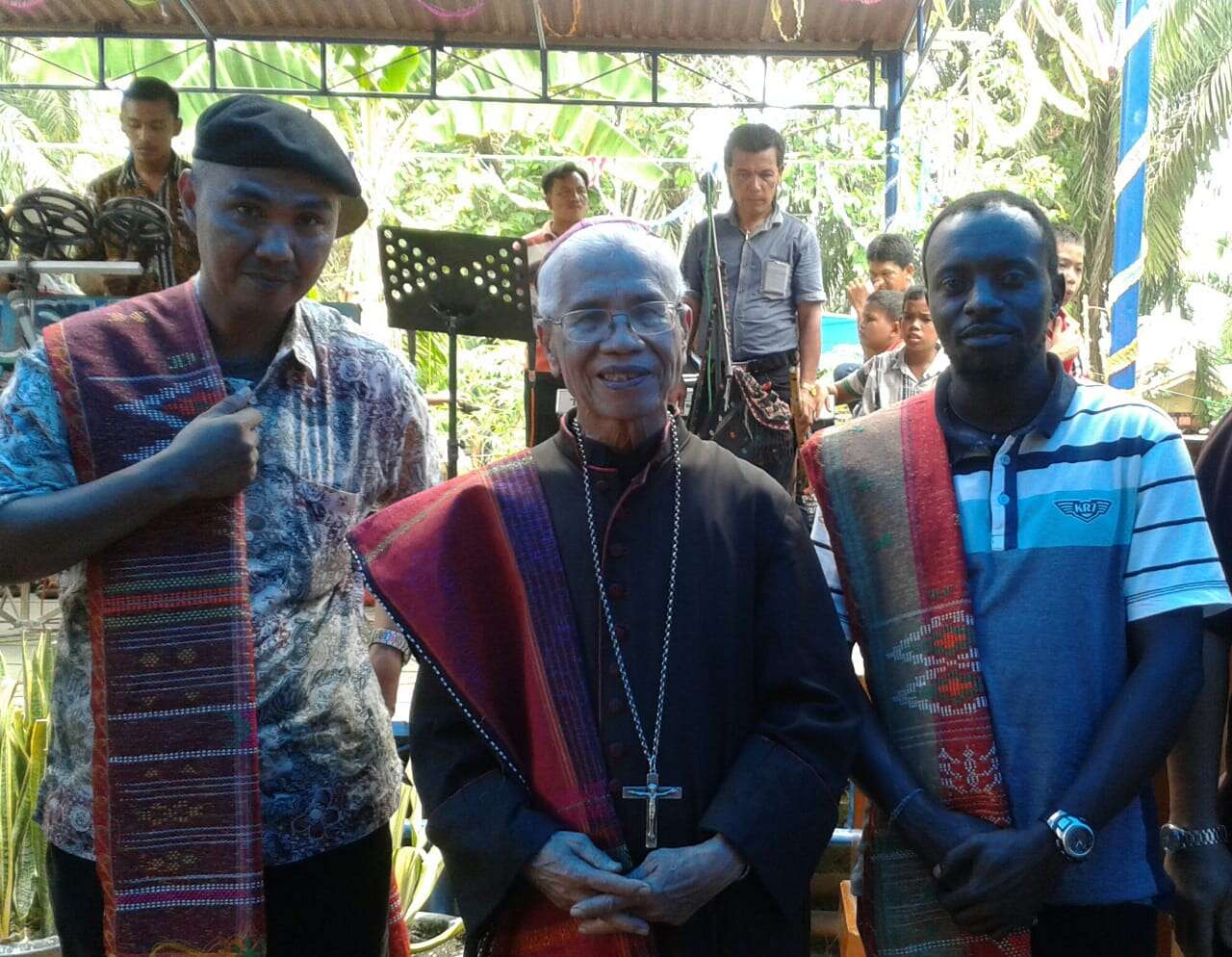
If the population of West Sumatra was predominantly Muslim, the region of North Sumatra where I am presently is predominantly Christian (Protestant). This is my second assignment since arriving in Indonesia about 8 years ago. For the sake of more effective and contextual missionary work in this new area, I started my mission by learning the language and the culture of the Batak people. However, learning a language without a formal school, but rather in living directly in a very simple family for 3 months really was a challenge and at the same time a “crazy” adventure. It is among the Batak people that I realized that I was a “prophet”. Batak people, especially my parishioners call me “nabi”. In Indonesian language, the word “nabi” means prophet or the messenger of Allah. However, the nickname “nabi” is in reality the shortened form for “nabirong” which in Batak Toba language means black man.
Whenever I meet children, young people and even adults, I am always greeted politely and respectfully. Some of them even thank God for being able to meet and shake hands with a black missionary. Doing mission here helped me realize that when we come to the encounter of other peoples not in our own name, but in the name of the one who called us, chose us and sent us to bear witness to the Gospel of the grace of God, then our presence among them becomes itself proclamation and also a possibility for praising God.
I often smile when I hear people feeling proud just because they have had their pictures taken with me; there are even children of the parish who laugh at their companions from other churches saying: “Our parish priest comes from abroad, but your pastor is only from this village!”
North Sumatra is certainly predominantly Christian, but it is still a land of mission where the need for a new evangelization is felt. Despite years of missionary presence in these lands, the Catholic faith is not yet fully lived out. This is the reason why when I was installed parish priest, I made that vow that I would not lay down any stones for the construction of churches. I rather I tried to revitalize catechesis and the liturgy, I worked with ecclesiastical tribunal for the convalidation of marriages, to reintegrate into the Catholic Church those who had gone astray, the pastoral care of families, children and the young people as well as missionary and vocation awareness.
- With the laity
As a regional council member and a parish priest, I was entrusted with the task of animating fellow Xaverian parish priests in the field of pastoral and missionary work. We met twice a year in order to exchange ideas and strategies on how to transform the parishes entrusted to us into more and more missionary parishes. We acknowledged that in this domain much is still to be done meaning we need to be more proactive and courageous to propose and try new initiatives, always keeping the pastoral policies of the different dioceses. But we can’t do everything alone. Indeed, this is only possible if we work for the formation of the laity and begin to consider them as partners on a mission. The statistics speak for themselves and they should alert us.
For example, the 2017 statistics of the Archdiocese of Medan in North Sumatra show that the number of Catholics is 528,444 people (including catechumens), spread in 1,342 chapels/stations over 63 parishes and quasi-parishes. The same statistics indicate that the total number of domiciled priests in the archdiocese is 252 people. In addition, there are 142 other priests indirectly involved in pastoral work and 110 others in non-pastoral ministries or commissions but they usually help parishes on Sundays.
By comparing the number of faithful (528,444 people) with the priests (142 people) directly in involved in parochial work, on average a single priest attended to 3,721 people, or is in charge of 9 chapels. If each priest working in the parish serves 2 chapels on Sunday, the mass is celebrated in 284 chapels. It means that there are still 1,040 chapels without weekly mass. Assuming that the 110 other non-resident priests celebrate each a mass per week, we will have 110 more masses in the chapels, which making up a total of 394 masses. But even with that, still there are many chapels not attended to on Sundays.
From the data above, we can clearly see that there is a real disparity between the number of priests and that of the faithful and chapels which need to be served. In other words, only 153,660 people (out of the 528,444 Catholics in the archdiocese) are cared for by priests on a weekly basis whereas as many as 374,784 people are not attended to.
In the absence of the priest for the celebration of the Eucharist and despite their limitations, it is the lay leaders who nourish the faithful with the Word of God. And we have never learned that a chapel was closed on Sundays because the Father so and so did not come. It is the same with the dispensation of catechesis, the funerals, etc. It is therefore clear that lay leaders play an important role in the pastoral care of the faithful. And it is our duty, as missionaries, to empower and train the laity so that together with them we can grow in missionary awareness in the Church.
- At the rendezvous of giving and receiving
On the day of my presbyteral ordination, the announcement of my assignment to Indonesia caused a great commotion among the faithful. Greeting me in the sacristy, a fellow friend and priest of the archdiocese of Bukavu even asked me what crime had I committed among the Xaverians so as to be sent far away from my country because in my own native parish there are faithful who cannot attend the mass for the lack of priests. In Indonesia, many people rise their eyebrows when I tell them that I am a missionary from the Democratic Republic of Congo, in Africa.
My assignment to Indonesia was not a punishment for any crime whatsoever, or an indifference on my part towards the real pastoral needs in my own country and my own parish. But it is part of the awareness of the missionary responsibility that falls upon us to proclaim the Gospel. And it is a rendezvous of giving and receiving.
According to the 2019 Ad Limina report of the Bishops of Indonesia, the number of Catholics nationwide is 8,095,834 persons or 3.3% of the 269,874,666 inhabitants of Indonesia. On the other hand, the number of priests is 4,782 consisting of 2,230 diocesans, 2,552 religious priests who are supported in the work by 1,604 brothers and 6,306 nuns. In addition there are 428 members of secular institutes. Yet, even though the Indonesian Church remains a pusillus grex and an extremely little flock with enormous pastoral needs like in northern Sumatra, it has also already started to send its priests, men and women religious, on mission to foreign lands, over all the continents and in many countries. And this missionary awareness is not only achieved by sending missionaries ad extra but also ad intra as part of the solidarity between the 37 dioceses in the country.
Conclusion
My missionary experience in western and northern Sumatra bore witness to the universality and missionary nature of the Church. The mission entrusted to the Church will continue to grow and find new and effective expressions which bring life and set the world on fire to the extent that both the local and universal church, both the ordained and non-ordained pastoral agents work hand in hand.
Introduction
Last year, we celebrated the centenary of Maximum Illud, the Apostolic Letter of Pope Benedict XV. The current Pope Francis wanted to celebrate it in a special way through an Extraordinary Missionary Month with the theme “Baptized and Sent: The Church of Christ on Mission in the World”. Through that special missionary month of October 2019, the Holy Father therefore wanted “to reawaken an awareness of the missio ad gentes, and reinvigorate the responsibility of proclaiming the Gospel with new enthusiasm for the transformation of life and the pastoral”. In this article, share my missionary experience ad gentes in western and northern Sumatra in Indonesia.
- A Pioneer among Muslims
I was the first African and Congolese Xaverian missionary to be sent to Indonesia, a predominantly Muslim country. To be honest, not being a mission country that I had chosen myself, I was a little bit surprised when I was told that I were assigned to Indonesia. In fact, my dream was to go on mission in China but the Superiors made another choice and I do not regret it.
I first arrived in Indonesia as a deacon in June 2012 but I only stayed there for a month before returning to the Congo for my priestly ordination. My second visit to Indonesia took place in November 2012 after my ordination. After six months of learning the Indonesian language in Jogjakarta, I was appointed as an assistant priest in three small parishes of West Sumatra among the Minangkabau people known for being radical Muslims.
Together with another confrere from Mexico we took care of those three small parishes of about 2,500 faithful. As a foreign missionary, an experience that I found interesting and very difficult to imagine in my own country was the fact that in certain regions of West Sumatra, Catholics and Protestants shared the same chapel on Sundays. As it were and still is difficult, if not impossible, to obtain the authorization or permit to build churches or chapels on Muslim soil, Catholics and Protestants were forced to forget their "disputes" about dogmas and take turns in using the same place of worship erected in a military camp.
As soon as the first Protestant group came out, I was already there with my faithful ready to start the celebration of the Eucharist. As we were prohibited from placing or leaving religious symbols (crucifixes, images, statues, candles) in the building, the first thing to do was to give a Catholic outlook to the room by placing these symbols of our faith on the small table. Before I even pronounced Ite missa est to dismiss the assembly, another group of Protestants with their Pastor was already ready to enter in. This circumstantial ecumenical dialogue remains a memorable and an unprecedented missionary experience for me.
For two years, I worked in the pastoral care for the children and young people which was stalled for some years. Beyond the pastoral difficulties and challenges that we encountered, I successfully revived this ministry. Furthermore, living and working in a predominantly Muslim community was also an opportunity to experience an important dimension of the Xaverian charism, namely inter-religious dialogue through life witness.
- In the land of new evangelization
If the population of West Sumatra was predominantly Muslim, the region of North Sumatra where I am presently is predominantly Christian (Protestant). This is my second assignment since arriving in Indonesia about 8 years ago. For the sake of more effective and contextual missionary work in this new area, I started my mission by learning the language and the culture of the Batak people. However, learning a language without a formal school, but rather in living directly in a very simple family for 3 months really was a challenge and at the same time a “crazy” adventure. It is among the Batak people that I realized that I was a “prophet”. Batak people, especially my parishioners call me “nabi”. In Indonesian language, the word “nabi” means prophet or the messenger of Allah. However, the nickname “nabi” is in reality the shortened form for “nabirong” which in Batak Toba language means black man.
Whenever I meet children, young people and even adults, I am always greeted politely and respectfully. Some of them even thank God for being able to meet and shake hands with a black missionary. Doing mission here helped me realize that when we come to the encounter of other peoples not in our own name, but in the name of the one who called us, chose us and sent us to bear witness to the Gospel of the grace of God, then our presence among them becomes itself proclamation and also a possibility for praising God.
I often smile when I hear people feeling proud just because they have had their pictures taken with me; there are even children of the parish who laugh at their companions from other churches saying: “Our parish priest comes from abroad, but your pastor is only from this village!”
North Sumatra is certainly predominantly Christian, but it is still a land of mission where the need for a new evangelization is felt. Despite years of missionary presence in these lands, the Catholic faith is not yet fully lived out. This is the reason why when I was installed parish priest, I made that vow that I would not lay down any stones for the construction of churches. I rather I tried to revitalize catechesis and the liturgy, I worked with ecclesiastical tribunal for the convalidation of marriages, to reintegrate into the Catholic Church those who had gone astray, the pastoral care of families, children and the young people as well as missionary and vocation awareness.
- With the laity
As a regional council member and a parish priest, I was entrusted with the task of animating fellow Xaverian parish priests in the field of pastoral and missionary work. We met twice a year in order to exchange ideas and strategies on how to transform the parishes entrusted to us into more and more missionary parishes. We acknowledged that in this domain much is still to be done meaning we need to be more proactive and courageous to propose and try new initiatives, always keeping the pastoral policies of the different dioceses. But we can’t do everything alone. Indeed, this is only possible if we work for the formation of the laity and begin to consider them as partners on a mission. The statistics speak for themselves and they should alert us.
For example, the 2017 statistics of the Archdiocese of Medan in North Sumatra show that the number of Catholics is 528,444 people (including catechumens), spread in 1,342 chapels/stations over 63 parishes and quasi-parishes. The same statistics indicate that the total number of domiciled priests in the archdiocese is 252 people. In addition, there are 142 other priests indirectly involved in pastoral work and 110 others in non-pastoral ministries or commissions but they usually help parishes on Sundays.
By comparing the number of faithful (528,444 people) with the priests (142 people) directly in involved in parochial work, on average a single priest attended to 3,721 people, or is in charge of 9 chapels. If each priest working in the parish serves 2 chapels on Sunday, the mass is celebrated in 284 chapels. It means that there are still 1,040 chapels without weekly mass. Assuming that the 110 other non-resident priests celebrate each a mass per week, we will have 110 more masses in the chapels, which making up a total of 394 masses. But even with that, still there are many chapels not attended to on Sundays.
From the data above, we can clearly see that there is a real disparity between the number of priests and that of the faithful and chapels which need to be served. In other words, only 153,660 people (out of the 528,444 Catholics in the archdiocese) are cared for by priests on a weekly basis whereas as many as 374,784 people are not attended to.
In the absence of the priest for the celebration of the Eucharist and despite their limitations, it is the lay leaders who nourish the faithful with the Word of God. And we have never learned that a chapel was closed on Sundays because the Father so and so did not come. It is the same with the dispensation of catechesis, the funerals, etc. It is therefore clear that lay leaders play an important role in the pastoral care of the faithful. And it is our duty, as missionaries, to empower and train the laity so that together with them we can grow in missionary awareness in the Church.
- At the rendezvous of giving and receiving
On the day of my presbyteral ordination, the announcement of my assignment to Indonesia caused a great commotion among the faithful. Greeting me in the sacristy, a fellow friend and priest of the archdiocese of Bukavu even asked me what crime had I committed among the Xaverians so as to be sent far away from my country because in my own native parish there are faithful who cannot attend the mass for the lack of priests. In Indonesia, many people rise their eyebrows when I tell them that I am a missionary from the Democratic Republic of Congo, in Africa.
My assignment to Indonesia was not a punishment for any crime whatsoever, or an indifference on my part towards the real pastoral needs in my own country and my own parish. But it is part of the awareness of the missionary responsibility that falls upon us to proclaim the Gospel. And it is a rendezvous of giving and receiving.
According to the 2019 Ad Limina report of the Bishops of Indonesia, the number of Catholics nationwide is 8,095,834 persons or 3.3% of the 269,874,666 inhabitants of Indonesia. On the other hand, the number of priests is 4,782 consisting of 2,230 diocesans, 2,552 religious priests who are supported in the work by 1,604 brothers and 6,306 nuns. In addition there are 428 members of secular institutes. Yet, even though the Indonesian Church remains a pusillus grex and an extremely little flock with enormous pastoral needs like in northern Sumatra, it has also already started to send its priests, men and women religious, on mission to foreign lands, over all the continents and in many countries. And this missionary awareness is not only achieved by sending missionaries ad extra but also ad intra as part of the solidarity between the 37 dioceses in the country.
Conclusion
My missionary experience in western and northern Sumatra bore witness to the universality and missionary nature of the Church. The mission entrusted to the Church will continue to grow and find new and effective expressions which bring life and set the world on fire to the extent that both the local and universal church, both the ordained and non-ordained pastoral agents work hand in hand.