
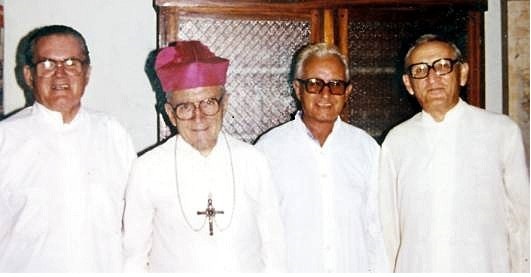
Fr. Vincent Munari, s.x
I have known Bishop Azzolini from January 1980 to January 1987; a short lease of time that coincided with his late and last activities in Sierra Leone, when his great strength exerted for the Kingdom of God, was beginning to decline. Anyway I have a series of things to remember that I try to put on paper. The first is my great admiration, amazement even, when I went around on the first visitation to our missions and I saw the great number of churches, houses, hospitals, schools spread throughout all the diocese of Makeni. The number of Catholics was not large but the Catholic Church was held in high esteem. I was convinced all this was the merit of the bishop, and this was confirmed by what the confreres were telling me.
Another aspect of Bishop Azzolini’s personality was his concern for his missionaries and for all the activities going on in the different missions. Once I also was taken to task by him because I went to Makeni from my mission and I did not go to visit him: that for him was unforgivable! He wanted to know everything of every aspect of the mission and this was his opportunity to stress the important points of the different activities and to indicate that what seems more attractive sometimes is less useful for our mission.
A situation that impressed me positively was also the fact that in the Makeni diocese the forms of lay participation to the pastoral ministry were more developed than in many Italian dioceses; Bishop Azzolini had taken seriously the pope’s directives and recommended to us missionaries that type of obedience: he wanted every parish to have at least a Parish council or committee and some kind of “Caritas”.
I came to admire him as a missionary full of zeal; sometimes polemic with us missionaries, taking holydays too literally; every year he used to carry out the pastoral visit to the whole diocese, and on that occasion he would visit everything, even the smallest village churches and village schools. Sometimes there was no road but he was expecting at least a delegation from those villages.
He was insisting on catechumenate and baptism in a way that reminded me of the “Compel them to enter” (Lc. 14, 23). And always he was asking about Christian marriages: he knew very well what was the richness of a family truly Christian and truly united.
One fact stands out clearly in my mind after so many years: he himself went to ring the church bell in Kamalo. We had previously arranged to start the pastoral visit at 4 pm with confessions. But I was in Kamakwie; the other father was supposed to be in Kamalo, but had problems in Maharibu… in the end the catechist comes, opens the church, then I arrived and we had a very good celebration because the faithful came in great number and everything was set.
One phrase he said to me that I find difficult to forget: “It is not right to miss opportunities for the Kingdom”. From the far villages delegations were coming to ask for a small church or a village school; I was inclined to say “no” because too much activity is not sustainable. I spoke to the bishop to ask his opinion but he thought otherwise.
Surely Bishop Azzolini did not miss chances: he stopped everyone, asked names and relations, activity, school, church etc. and, above all, he was always speaking about Christ, the gospel, eternal salvation. He was a real pastor who learned and was putting into practice the recommendation of St. Paul: “Insist in opportune and inopportune time, exhort, etc” (Cf. 2 Tim 4, 2)…He was literally applying this word of God.
I have known Bishop Azzolini from January 1980 to January 1987; a short lease of time that coincided with his late and last activities in Sierra Leone, when his great strength exerted for the Kingdom of God, was beginning to decline. Anyway I have a series of things to remember that I try to put on paper. The first is my great admiration, amazement even, when I went around on the first visitation to our missions and I saw the great number of churches, houses, hospitals, schools spread throughout all the diocese of Makeni. The number of Catholics was not large but the Catholic Church was held in high esteem. I was convinced all this was the merit of the bishop, and this was confirmed by what the confreres were telling me.
Another aspect of Bishop Azzolini’s personality was his concern for his missionaries and for all the activities going on in the different missions. Once I also was taken to task by him because I went to Makeni from my mission and I did not go to visit him: that for him was unforgivable! He wanted to know everything of every aspect of the mission and this was his opportunity to stress the important points of the different activities and to indicate that what seems more attractive sometimes is less useful for our mission.
A situation that impressed me positively was also the fact that in the Makeni diocese the forms of lay participation to the pastoral ministry were more developed than in many Italian dioceses; Bishop Azzolini had taken seriously the pope’s directives and recommended to us missionaries that type of obedience: he wanted every parish to have at least a Parish council or committee and some kind of “Caritas”.
I came to admire him as a missionary full of zeal; sometimes polemic with us missionaries, taking holydays too literally; every year he used to carry out the pastoral visit to the whole diocese, and on that occasion he would visit everything, even the smallest village churches and village schools. Sometimes there was no road but he was expecting at least a delegation from those villages.
He was insisting on catechumenate and baptism in a way that reminded me of the “Compel them to enter” (Lc. 14, 23). And always he was asking about Christian marriages: he knew very well what was the richness of a family truly Christian and truly united.
One fact stands out clearly in my mind after so many years: he himself went to ring the church bell in Kamalo. We had previously arranged to start the pastoral visit at 4 pm with confessions. But I was in Kamakwie; the other father was supposed to be in Kamalo, but had problems in Maharibu… in the end the catechist comes, opens the church, then I arrived and we had a very good celebration because the faithful came in great number and everything was set.
One phrase he said to me that I find difficult to forget: “It is not right to miss opportunities for the Kingdom”. From the far villages delegations were coming to ask for a small church or a village school; I was inclined to say “no” because too much activity is not sustainable. I spoke to the bishop to ask his opinion but he thought otherwise.
Surely Bishop Azzolini did not miss chances: he stopped everyone, asked names and relations, activity, school, church etc. and, above all, he was always speaking about Christ, the gospel, eternal salvation. He was a real pastor who learned and was putting into practice the recommendation of St. Paul: “Insist in opportune and inopportune time, exhort, etc” (Cf. 2 Tim 4, 2)…He was literally applying this word of God.