
Fr. Adolph Guy sx
Dear brothers and sisters,
There are times in our lives as individuals, a family, or as a Christian community when we go through moments of pain, sadness, and bitterness due to a disappointment, a failure in love life or work, or death – especially that of a loved one. Questions such as ' Where is God?' in this particular time arise in our minds.
This Sunday is the 19th of the Ordinary Time, cycle A. The experience of Prophet Elijah in the first reading (1Kings 19:9, 11-13) and that of the disciples in the stormy sea (Mt 14:22-33) assure us that the Lord God never deserts us even in dire times. The Lord God abides with us, always. We just need to pour out all our souls to him, like the Prophet Elijah and Saint Peter, before us.
Before reflecting on these two figures, a short anecdote can help us grasp the abiding presence of God in our lives. There was a man who used to walk with God. Every day as he walked on foot, he was accustomed to seeing two sets of footprints beside his own. However, it so happens that whenever he was going through hardships, the man would notice only a single set of footmarks, which he thought to be his. This happened so often that he wondered why God usually abandoned him in times of difficulties. Hence, he asked God: “Why do you abandon me when I go through turbulent moments?” God replied: “I have never deserted you. Instead, I carried you in my arms; as a matter of fact, the footprints that you see are mine.” What a shocking revelation!
A similar situation happened to the Prophet Elijah in the first reading we have just heard. In 1 Kings 19, there came a time Elijah said: “It is enough; now, O Lord, take away my life…” He was tired, hungry, and exhausted from the long journey in the wilderness. What is more, he was the only remaining Prophet of Yahweh in Israel. Worse still, Queen Jezebel had issued an arrest warrant with a death threat to the person of the Prophet. Everything seemed to be hopeless, a story that was going nowhere. However, little Elijah knew that God was not only caring for him but carrying him: an angel was sent on his way to attend to him when he was at the brink of despair. And on the mount Horeb, God addressed Elijah’s concerns. New Kings were to be anointed in replacement of the corrupt ones, and a new prophet in his place was called to continue God’s work in Israel.
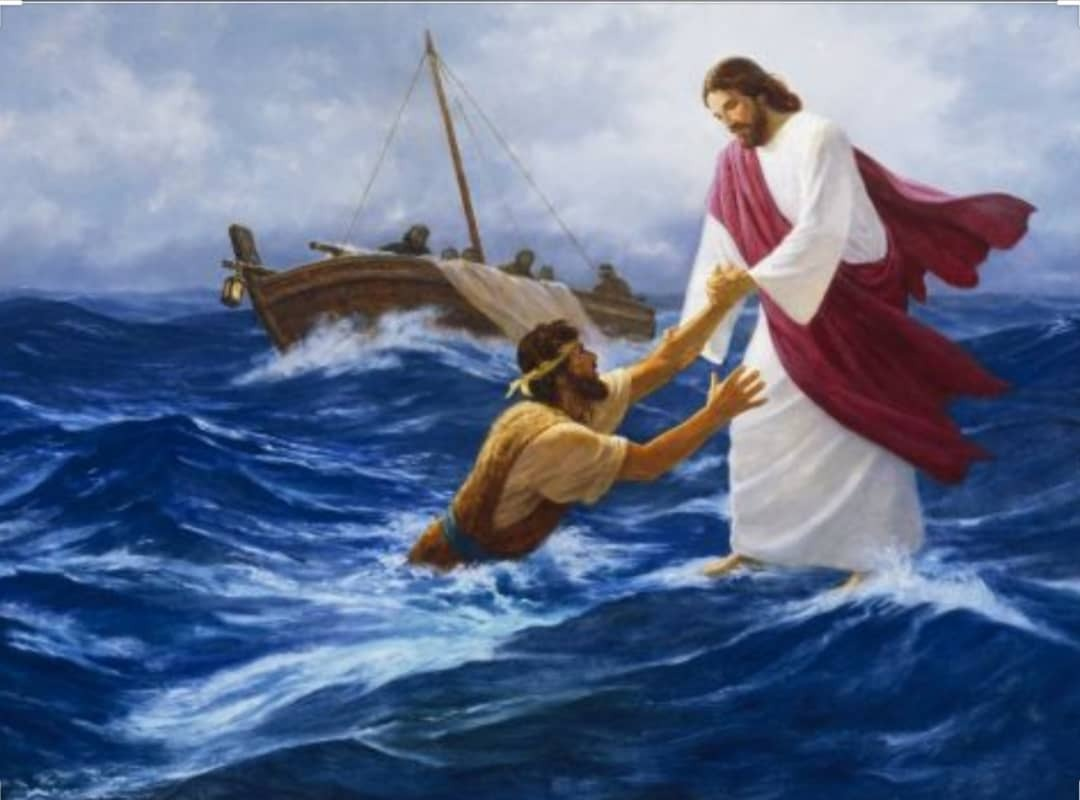
Likewise, when we face challenges in our life, it is good to cry to the Lord, as Peter did in the Gospel story. The Lord Jesus comes to the help of the Church. Peter and the other disciples were going through a tough time. The Gospel says that the boat was battling against a massive storm, and Jesus was not with his disciples at that particular moment. Yet, Jesus walked through stormy waters to the rescue of Peter and companions. Allow me to be a bit more explicit here. Peter’s boat is indeed one of the traditional icons of the Church. We remember earlier in the Gospel of Matthew (4: 18-27) when the Lord Jesus called Peter and Andrew and told them: “Follow me, and I will make you fish for people.” Therefore, Peter and the other disciples gather us in the Church. On the other hand, in biblical language, water is the symbol of life and purification. But it also entails a potential death and can be an occasion of danger—such as in Noah’s flood or the story of Jonah. In his "Jesus, A Pilgrimage " James Martin writes: “Raging seas and howling storms would have represented to Jesus’ contemporaries chaos and danger.”
The boat without Jesus is exposed to storms. If we lose sight of Jesus in our coming together as a church, our parish and basic ecclesial community will be at the mercy of tribalism, regional, ethnic, or ideological divisions as well as other human perception at our fellow Christians. Christ's presence is so important that New Testament writers name Jesus the cornerstone which holds everything together. Aside from the Altar in our Church, the sanctuary lamp highlights the Lord Jesus' permanent presence among us. Timothy Radcliffe explains: “The sanctuary lamp is a sign of the presence of Christ in the tabernacle. Christ abides in our churches, even when there is no one in the Church. He remains even when the parish community braces itself for an imminent crisis, even when the priest is a failure. He does not go away.” The Lord Jesus abides “with us through all the chaos of history, the accidental disasters, the wars, and earthquakes […] “Christ remains steadily here with us, Emmanuel, God with us, today as he was yesterday and will be tomorrow.”
Let us learn, therefore, from Prophet Elijah and Saint Peter to pour out our heart to God in the turbulent moments of our life journey. The Lord Jesus promises to give us rest because his yoke is easy and his burden light (Mt 11:28-30).
Dear brothers and sisters,
There are times in our lives as individuals, a family, or as a Christian community when we go through moments of pain, sadness, and bitterness due to a disappointment, a failure in love life or work, or death – especially that of a loved one. Questions such as ' Where is God?' in this particular time arise in our minds.
This Sunday is the 19th of the Ordinary Time, cycle A. The experience of Prophet Elijah in the first reading (1Kings 19:9, 11-13) and that of the disciples in the stormy sea (Mt 14:22-33) assure us that the Lord God never deserts us even in dire times. The Lord God abides with us, always. We just need to pour out all our souls to him, like the Prophet Elijah and Saint Peter, before us.
Before reflecting on these two figures, a short anecdote can help us grasp the abiding presence of God in our lives. There was a man who used to walk with God. Every day as he walked on foot, he was accustomed to seeing two sets of footprints beside his own. However, it so happens that whenever he was going through hardships, the man would notice only a single set of footmarks, which he thought to be his. This happened so often that he wondered why God usually abandoned him in times of difficulties. Hence, he asked God: “Why do you abandon me when I go through turbulent moments?” God replied: “I have never deserted you. Instead, I carried you in my arms; as a matter of fact, the footprints that you see are mine.” What a shocking revelation!
A similar situation happened to the Prophet Elijah in the first reading we have just heard. In 1 Kings 19, there came a time Elijah said: “It is enough; now, O Lord, take away my life…” He was tired, hungry, and exhausted from the long journey in the wilderness. What is more, he was the only remaining Prophet of Yahweh in Israel. Worse still, Queen Jezebel had issued an arrest warrant with a death threat to the person of the Prophet. Everything seemed to be hopeless, a story that was going nowhere. However, little Elijah knew that God was not only caring for him but carrying him: an angel was sent on his way to attend to him when he was at the brink of despair. And on the mount Horeb, God addressed Elijah’s concerns. New Kings were to be anointed in replacement of the corrupt ones, and a new prophet in his place was called to continue God’s work in Israel.
Likewise, when we face challenges in our life, it is good to cry to the Lord, as Peter did in the Gospel story. The Lord Jesus comes to the help of the Church. Peter and the other disciples were going through a tough time. The Gospel says that the boat was battling against a massive storm, and Jesus was not with his disciples at that particular moment. Yet, Jesus walked through stormy waters to the rescue of Peter and companions. Allow me to be a bit more explicit here. Peter’s boat is indeed one of the traditional icons of the Church. We remember earlier in the Gospel of Matthew (4: 18-27) when the Lord Jesus called Peter and Andrew and told them: “Follow me, and I will make you fish for people.” Therefore, Peter and the other disciples gather us in the Church. On the other hand, in biblical language, water is the symbol of life and purification. But it also entails a potential death and can be an occasion of danger—such as in Noah’s flood or the story of Jonah. In his "Jesus, A Pilgrimage " James Martin writes: “Raging seas and howling storms would have represented to Jesus’ contemporaries chaos and danger.”
The boat without Jesus is exposed to storms. If we lose sight of Jesus in our coming together as a church, our parish and basic ecclesial community will be at the mercy of tribalism, regional, ethnic, or ideological divisions as well as other human perception at our fellow Christians. Christ's presence is so important that New Testament writers name Jesus the cornerstone which holds everything together. Aside from the Altar in our Church, the sanctuary lamp highlights the Lord Jesus' permanent presence among us. Timothy Radcliffe explains: “The sanctuary lamp is a sign of the presence of Christ in the tabernacle. Christ abides in our churches, even when there is no one in the Church. He remains even when the parish community braces itself for an imminent crisis, even when the priest is a failure. He does not go away.” The Lord Jesus abides “with us through all the chaos of history, the accidental disasters, the wars, and earthquakes […] “Christ remains steadily here with us, Emmanuel, God with us, today as he was yesterday and will be tomorrow.”
Let us learn, therefore, from Prophet Elijah and Saint Peter to pour out our heart to God in the turbulent moments of our life journey. The Lord Jesus promises to give us rest because his yoke is easy and his burden light (Mt 11:28-30).