
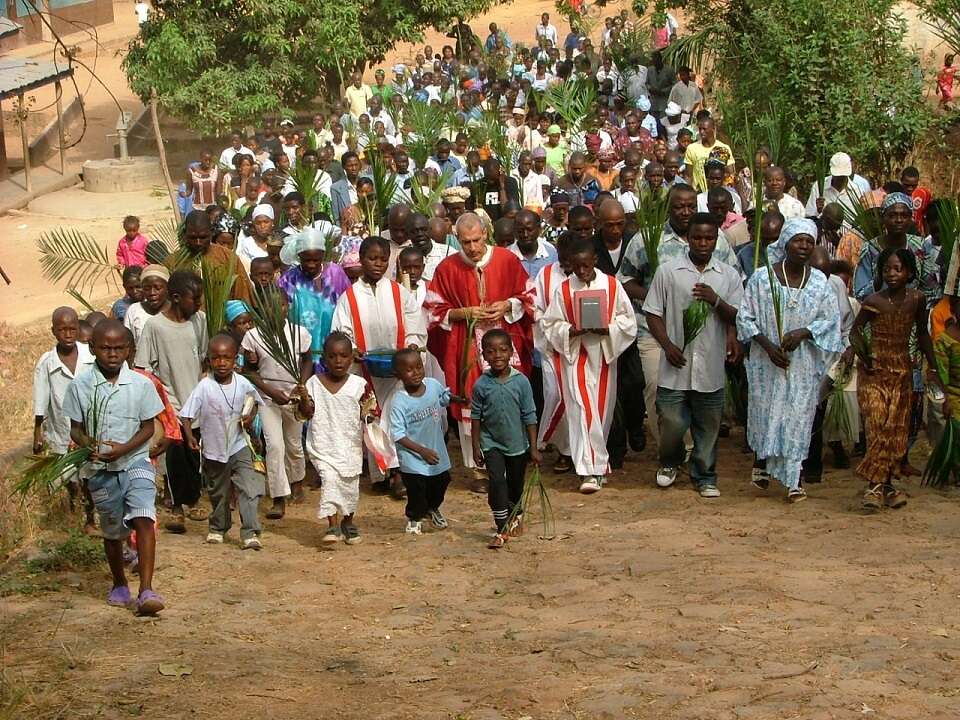
Fr. Carlo Di Sopra sx
Palm Sunday Cycle B
Palm Sunday Cycle B
Passion, Death and Resurrection of Christ: this is the heart of our Christian faith, the first and fundamental announcement of the Apostles at the beginning of the Church journey after Pentecost, the key to enter into the mystery of God, Holy Trinity. Everything is celebrated during the Holy Week, a week intense and filled with incredible events that have the power to change the meaning of our life and the history of the world.
The beginning is solemn, Jesus enters into Jerusalem amid jubilation: Blessed the one who comes in the name of the Lord to establish the kingdom of our father David. Hosanna, come to save us now! Jesus is recognised the Saviour, the Messiah, and this is the right time for Israel to become great again, and for the Kingdom of God to be established forever. During the Holy Week Jesus will do all this, but in a way that people could not have imagined and which also for us is difficult to understand. He will save his people, but by dying on the cross.
How can this be? Can the weak one, the loser, the abandoned, the dying one save? He cannot save himself, how can he save others? How not to see the contradiction between the first part of this Palm Sunday and the second, when we read the Passion? From Palms of jubilation to Passion!
If Jesus is God, how can he die on the cross? No wonder many people, even today, cannot understand the Christians when they expose the Crucifix in churches and in places where they live.
What we see as contradiction, however, is coherence on the side of God. Since God is love, he cannot affirm himself in the way we usually do, by a show of power, or by imposing himself. He establishes his kingdom by giving up even his divinity, his humanity, everything he possesses, like the precious relationship with the Father.
When Jesus remains alone on the cross, after having given everything, what is left? Only love! Only God. And this is the resurrection.
Jesus had tried many times to prepare his disciples for this moment: the first will become last, and the last first; the first has to serve; if you give, you will receive; if you keep your life, you lose it, if you lose your life you gain it; there is no grater love than to give one's life; God so loved the world that he gave his Son...”
We are all called to this far from easy conversion, to see the greatness of God when he dies out of love, and to try to be perfect as God is perfect, or merciful, as He is merciful.
Pope Francis, on the way back from his recent visit to Iraq, explained how, if we want to see a world where all become BROTHERS AND SISTERS, we have to embrace the way of Jesus, we have to affirm ourselves by putting ourselves down and by giving priority to the least, those who suffer most, the losers, the abandoned and the marginalised. This is the way that Jesus showed and opened up for humanity. Pope Francis also said that many Christians might criticise him for speaking like this, instead of giving a show of God's almighty power and of a triumphant Church. It can be risky to embrace a wounded humanity, but did not Jesus do the same? Did he not take the same risk?
Passion, Death and Resurrection of Christ: this is the heart of our Christian faith, the first and fundamental announcement of the Apostles at the beginning of the Church journey after Pentecost, the key to enter into the mystery of God, Holy Trinity. Everything is celebrated during the Holy Week, a week intense and filled with incredible events that have the power to change the meaning of our life and the history of the world.
The beginning is solemn, Jesus enters into Jerusalem amid jubilation: Blessed the one who comes in the name of the Lord to establish the kingdom of our father David. Hosanna, come to save us now! Jesus is recognised the Saviour, the Messiah, and this is the right time for Israel to become great again, and for the Kingdom of God to be established forever. During the Holy Week Jesus will do all this, but in a way that people could not have imagined and which also for us is difficult to understand. He will save his people, but by dying on the cross.
How can this be? Can the weak one, the loser, the abandoned, the dying one save? He cannot save himself, how can he save others? How not to see the contradiction between the first part of this Palm Sunday and the second, when we read the Passion? From Palms of jubilation to Passion!
If Jesus is God, how can he die on the cross? No wonder many people, even today, cannot understand the Christians when they expose the Crucifix in churches and in places where they live.
What we see as contradiction, however, is coherence on the side of God. Since God is love, he cannot affirm himself in the way we usually do, by a show of power, or by imposing himself. He establishes his kingdom by giving up even his divinity, his humanity, everything he possesses, like the precious relationship with the Father.
When Jesus remains alone on the cross, after having given everything, what is left? Only love! Only God. And this is the resurrection.
Jesus had tried many times to prepare his disciples for this moment: the first will become last, and the last first; the first has to serve; if you give, you will receive; if you keep your life, you lose it, if you lose your life you gain it; there is no grater love than to give one's life; God so loved the world that he gave his Son...”
We are all called to this far from easy conversion, to see the greatness of God when he dies out of love, and to try to be perfect as God is perfect, or merciful, as He is merciful.
Pope Francis, on the way back from his recent visit to Iraq, explained how, if we want to see a world where all become BROTHERS AND SISTERS, we have to embrace the way of Jesus, we have to affirm ourselves by putting ourselves down and by giving priority to the least, those who suffer most, the losers, the abandoned and the marginalised. This is the way that Jesus showed and opened up for humanity. Pope Francis also said that many Christians might criticise him for speaking like this, instead of giving a show of God's almighty power and of a triumphant Church. It can be risky to embrace a wounded humanity, but did not Jesus do the same? Did he not take the same risk?