
Fr. Marsel R. Taruk sx
2nd Sunday of Easter
2nd Sunday of Easter
The stories around post resurrection of Jesus portray the early Christian Community as recorded in the first reading: one heart, one mind, no one of the community members claimed anything as his or her own. There were no needy in their midst, and each one was provided for according to need. A transformation of community is the first fruit of the resurrection, as shown in the account of the earliest community; however, the community hidden behind locked doors, the community hiding in fear, reveals that perhaps not all was sweetness and brightness.
The scandal of the crucifixion had scattered the disciples, the first community formed by Jesus; the community was somehow in a state of uneasiness, loss of direction. They were terrified, there was fear and grave disappointment. They were in hiding. They had individually and collectively lost their original names. What provided the occasion for a renewed presence of Jesus in the community was the fact that they were gathered together in his name. Instead of reproach, the first word of the risen Lord is “Peace be with you.” The disciples “rejoiced when they saw the Lord.” They were divested of their fear, shame, and old names. They were inspired by the Holy Spirit and their belief in the Resurrection of Jesus to a freer way of looking at life on this earth.
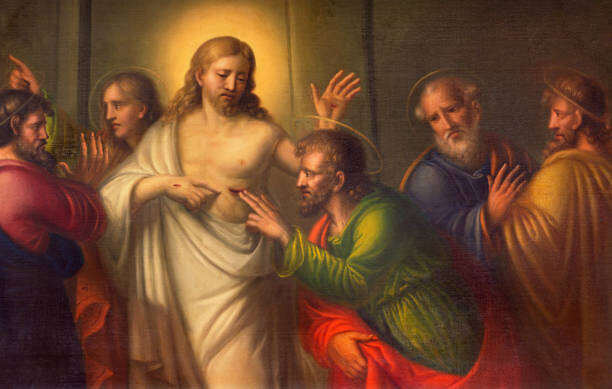
Interestingly to note as Scripture recounts that “it happened” that Thomas was absent when Jesus came. Later the community greets Thomas with the words, “We have seen the Lord.” And he quite simply refuses to accept their testimony. “Unless I see the mark of the nails in his hands and put my finger into the nail marks and put my hand into his side, I will not believe.”
Thomas is the first Christian to dissent formally from a fundamental conviction of the gathered church. After all, he does not believe in their testimony to the Resurrection. Thomas is a figure that represents most of us. There is nothing wrong in Thomas’ doubt about the testimony of the community, in my opinion, since rationality is also a gift from the Lord. The main problem of Thomas is that he cut himself off from the community. He went in his own way to find the answer of what had happened to Jesus during the last three days; to overcome his frustration and disappointment.
Fortunately, Thomas did not harden himself against the testimony of the community. At least he did not put himself out of and above the gathered disciples, church. He may have had the attitude of a dissenter, but it was in the context of Christ as the centre of their relationship. Thomas, though was in doubt, still shows humility and openness and remains with the community and they seem to welcome him. In fact, the next time Jesus appears in their midst, a week later, Thomas is present. And Jesus speaks directly to him: “Do not persist in your unbelief, but believe.” And the reply of Thomas, the doubter, the unbeliever in the strongest divinity text of the New Testament, says, “My Lord and my God.” Such is the transformative power of resurrection faith.
One thing is sure, the transformation of the community takes place when the risen Lord is truly present and experienced by the community. I always thank the Lord for the gift of faith and of His Church. We may experience hard time, disappointment or difficulty with our community, with our Church, but it should not drive us out of the community. The experience of Thomas teaches us to remain faithful to His church, no matter how difficult it may be. Let us always remember the very words of Jesus to the 'Thomas' in us: “Enter the wounds: the wounds of my humanity, of my church, of my crucified body, of my risen body and of my mystical body.”
The stories around post resurrection of Jesus portray the early Christian Community as recorded in the first reading: one heart, one mind, no one of the community members claimed anything as his or her own. There were no needy in their midst, and each one was provided for according to need. A transformation of community is the first fruit of the resurrection, as shown in the account of the earliest community; however, the community hidden behind locked doors, the community hiding in fear, reveals that perhaps not all was sweetness and brightness.
The scandal of the crucifixion had scattered the disciples, the first community formed by Jesus; the community was somehow in a state of uneasiness, loss of direction. They were terrified, there was fear and grave disappointment. They were in hiding. They had individually and collectively lost their original names. What provided the occasion for a renewed presence of Jesus in the community was the fact that they were gathered together in his name. Instead of reproach, the first word of the risen Lord is “Peace be with you.” The disciples “rejoiced when they saw the Lord.” They were divested of their fear, shame, and old names. They were inspired by the Holy Spirit and their belief in the Resurrection of Jesus to a freer way of looking at life on this earth.
Interestingly to note as Scripture recounts that “it happened” that Thomas was absent when Jesus came. Later the community greets Thomas with the words, “We have seen the Lord.” And he quite simply refuses to accept their testimony. “Unless I see the mark of the nails in his hands and put my finger into the nail marks and put my hand into his side, I will not believe.”
Thomas is the first Christian to dissent formally from a fundamental conviction of the gathered church. After all, he does not believe in their testimony to the Resurrection. Thomas is a figure that represents most of us. There is nothing wrong in Thomas’ doubt about the testimony of the community, in my opinion, since rationality is also a gift from the Lord. The main problem of Thomas is that he cut himself off from the community. He went in his own way to find the answer of what had happened to Jesus during the last three days; to overcome his frustration and disappointment.
Fortunately, Thomas did not harden himself against the testimony of the community. At least he did not put himself out of and above the gathered disciples, church. He may have had the attitude of a dissenter, but it was in the context of Christ as the centre of their relationship. Thomas, though was in doubt, still shows humility and openness and remains with the community and they seem to welcome him. In fact, the next time Jesus appears in their midst, a week later, Thomas is present. And Jesus speaks directly to him: “Do not persist in your unbelief, but believe.” And the reply of Thomas, the doubter, the unbeliever in the strongest divinity text of the New Testament, says, “My Lord and my God.” Such is the transformative power of resurrection faith.
One thing is sure, the transformation of the community takes place when the risen Lord is truly present and experienced by the community. I always thank the Lord for the gift of faith and of His Church. We may experience hard time, disappointment or difficulty with our community, with our Church, but it should not drive us out of the community. The experience of Thomas teaches us to remain faithful to His church, no matter how difficult it may be. Let us always remember the very words of Jesus to the 'Thomas' in us: “Enter the wounds: the wounds of my humanity, of my church, of my crucified body, of my risen body and of my mystical body.”