
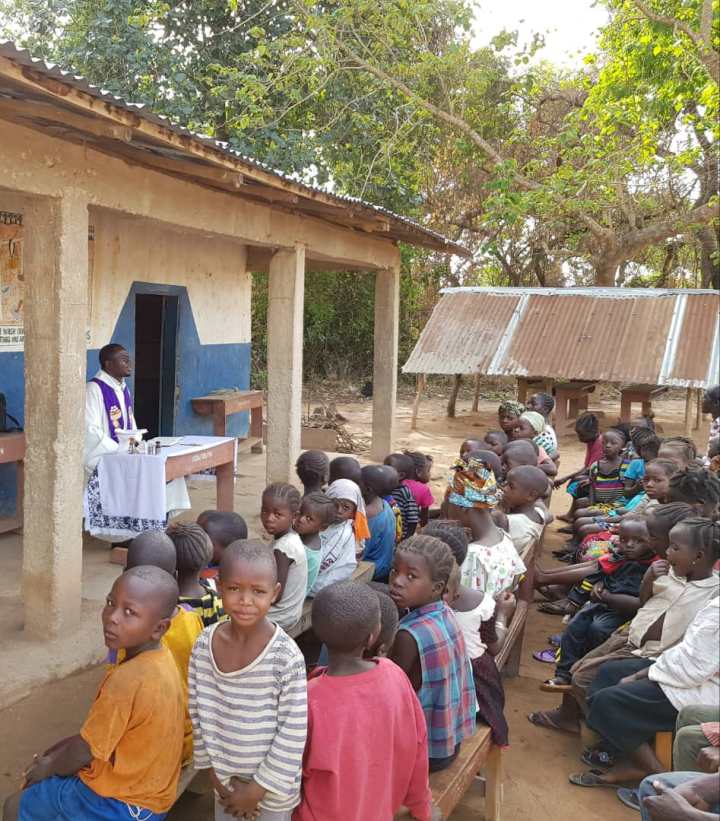
Fr. Adolph Guy sx
As we prepare ourselves to celebrate the missionary month this coming October, Maximum illud rekindles the missionary impulse within the church. It shows us with great admiration different apostles who carried the good news in different parts of the world in order to encourage and to foster the missionary enterprise among Christians.[1] Indeed, it involves everybody, from missionaries –in various places where they found themselves in the globe, with their respective religious congregations and superiors—to the local clergy and lay people passing through many offices up to his holiness. All of us have the duty to spread the Christian faith in the hope to make the whole world a single family in Christ.
Our Lady Mary Queen of the Apostles, Mongo Bendugu – where I am serving as missionary— is one of the 27 parishes that make up the diocese of Makeni. It is in the periphery of the diocese, and the only parish in the entire Falaba district. Historically, the Islamic religion entered Sierra Leone long before Christianity from this northern side of the country. This may explain why Christians are a tiny minority among Muslims whose elites are mostly trained in nearby Guinea. I know nothing about Guinea and still less about Islam as a religion, however, the common talk I hear around is that the training received in Guinea bears a whiff of resistance to Christianity and some of the things that are typically western.
My sharing has two parts. The first part is made up of two observations regarding the people around us and our missionary activity. The second part will focus on my personal impressions or struggles. They are not universal truth, by the way, they are really personal in the sense that they are deeply related to my own person.
Two observations
Firstly, most of the people in this area have already an experience of God. Different from the Christian God, but it is an experience of God nonetheless. I interact with some of them and I see how convinced they are about their faith. The month of Ramadan, which has now come to an end, offers another valuable opportunity to admire their faith. All in all, their belief in God permeates different areas of life and shapes the society. Cases of conversion are still possible as it is the work of God (John 6: 44). But are we to aim at it as if it were the sole purpose of mission? Otherwise, we can also preach the Jesus who is close to the poor, heals the sick, feeds the hungry, who is compassionates to sinners, who comforts the afflicted, etc. In fact, the life of Christ, says Saint John Paul II, ``speaks, also, to many who are not capable of repeating with Peter: ‘You are the Christ, the Son of the living God.’ He, the Son of the living God, speaks to people also as Man: it is his life that speaks, his humanity, his fidelity to the truth, his all-embracing love.”[2] In this light, I think we can make a deep impression on non-Christians even though they do not become members of the Church.
Secondly, our missionary activities include charity works. From the perspective of the local population –with a low literacy rate and shortsighted horizon, possibly due to the lack of information and education— it may be difficult for them to distinguish the Church from an NGO as many of these are popping up in this side of the country. From an outsider’s perspective, many NGOs operating here have some restrictions in their interaction with the local people, just as we, religious missionaries, have some restrictions owing to our lifestyle. We and these NGOs use the same brand of cars. Both our personnel tend to be mainly international since we are made up of people coming from different countries. However, confusing the Church to an NGO has some implication on how people can ask to be baptized and what they expect from the Church. Some join the Church because they expect to pursue their higher studies under the sponsorship of the Church. Others may become Christians out of gratitude to the person of the missionary who helped them. In many cases the newly converted person’s allegiance to the local church is partial inasmuch as it depends on the presence of the person who helped him/her in that particular community. This affects the nascent Christian community when priests are assigned to a different place, or when new priests are assigned in that particular church.
In addition, my experience of renovating some of our schools and chapels these last two years have also caused to think about the need of clarifying that we are the Church and not an NGO. Without any wish of mine to personalize these achievement on myself, all the praises from the people are directed to me because I am the one interacting with villages stakeholders and workers. But the truth is that I am just representing my congregation and the Church. I just do what I was asked to. In this sense, talks that were going on in the five or ten years about the distinction between the Church and NGOs can still be relevant up to this time.
Personal impression
Coming from a country where Christianity has a strong tradition after many centuries of evangelization, and after doing a part of my religious and priestly training in Metro-Manila where our confreres are constantly busy with the ministry—masses, house and funeral blessings, recollection, confession, retreat etc; it takes a great deal of time to fully appreciate the effort of our first missionary experience in this part of the diocese. In fact, we are still talking of the first proclamation not because this side of the country has not yet seen missionaries. Our elderly confreres tell us that one of the pioneers of our mission in Sierra Leone Fr Serafino Peter Calza reached this place in the late 1950s and built a primary school. Instead, we talk of the first announcement because, firstly, being in a rural area, most of our youth migrate to bigger cities to pursue their studies or to find a job. Since we are just a nascent and small Christian community, their absence is bitterly felt. Secondly, our weekly pastoral work is mainly teaching catechesis in some of our primary schools where we meet children coming from non-Christian families. Therefore, we are continually rebuilding Christian communities in most of our outstations.
Our apostolic life is united to religious life. In my view, religious life in this particular case alludes to all the components that make up our Xaverian identity and what catches the eyes at first is the community life, which draws its inspiration from the family spirit. In the front line, because we come from different backgrounds[3] (C37), it is difficult sometimes in community meetings to come up with a consensus that governs and harmonizes our pastoral and our community life. Many times, personal preferences are rationally presented to look like community needs. Consequently, the community swings from one extreme to the other as some members are coming in and others are going out. I am not immune of this tendency. On the other hand, when one observes the impact of the extreme positions on the people we are serving; honestly one may notice that a fraction of the people may be fully satisfied while the other half may probably have a mixed feeling. In krio, we sigh wondering “how fo do?” (What to do?). Saint Paul would have replied in a very simple way: “Just this, that Christ is proclaimed in every way …and in that I rejoice (Phil 1:18).
The whole idea of the first proclamation is what attracted us to the congregation. It is a common talk within the congregation, as our major documents state it boldly and clearly. In the last five years, I remember how romantic we were when we shared about it without any experience of our own, perhaps because we had listened to different experiences of some Fathers. Now in the mission, I wrestle with it to let it sink in me. I find out that it does not come without extra effort or frustration or some moments of discouragement. At times, I fancy being in another place and celebrating the Eucharist with a huge congregation or in a beautiful church and enjoy the good interaction with the Christian community. Then, arise some kind of questions such as: so why stay here and not there? Quite often, a similar question returns to me: why not here but there? Yes, this journey is not to be taken for granted. It is not automatic. Perhaps it is a journey in which Saint Paul put Christ as the target (Gal 4:19).
In line with all this, I like to read to myself this piece of advice from Saint Guido Maria Conforti: “If we remain faithful to the Institute to which we have given our name, observe its Constitutions and work under the direction of its superiors, we will acquire much merit, save many souls and obtain the reward reserved to those who put their hand to the plough without looking back: the hundredfold that Christ promised in a special way to his Apostles.”[4]
[1] Maximum Illud, no 7.
[2] Redemptor Hominis, no 7.
[3] Constitutions 37.
[4] Testament Letter, no 3.
As we prepare ourselves to celebrate the missionary month this coming October, Maximum illud rekindles the missionary impulse within the church. It shows us with great admiration different apostles who carried the good news in different parts of the world in order to encourage and to foster the missionary enterprise among Christians.[1] Indeed, it involves everybody, from missionaries –in various places where they found themselves in the globe, with their respective religious congregations and superiors—to the local clergy and lay people passing through many offices up to his holiness. All of us have the duty to spread the Christian faith in the hope to make the whole world a single family in Christ.
Our Lady Mary Queen of the Apostles, Mongo Bendugu – where I am serving as missionary— is one of the 27 parishes that make up the diocese of Makeni. It is in the periphery of the diocese, and the only parish in the entire Falaba district. Historically, the Islamic religion entered Sierra Leone long before Christianity from this northern side of the country. This may explain why Christians are a tiny minority among Muslims whose elites are mostly trained in nearby Guinea. I know nothing about Guinea and still less about Islam as a religion, however, the common talk I hear around is that the training received in Guinea bears a whiff of resistance to Christianity and some of the things that are typically western.
My sharing has two parts. The first part is made up of two observations regarding the people around us and our missionary activity. The second part will focus on my personal impressions or struggles. They are not universal truth, by the way, they are really personal in the sense that they are deeply related to my own person.
Two observations
Firstly, most of the people in this area have already an experience of God. Different from the Christian God, but it is an experience of God nonetheless. I interact with some of them and I see how convinced they are about their faith. The month of Ramadan, which has now come to an end, offers another valuable opportunity to admire their faith. All in all, their belief in God permeates different areas of life and shapes the society. Cases of conversion are still possible as it is the work of God (John 6: 44). But are we to aim at it as if it were the sole purpose of mission? Otherwise, we can also preach the Jesus who is close to the poor, heals the sick, feeds the hungry, who is compassionates to sinners, who comforts the afflicted, etc. In fact, the life of Christ, says Saint John Paul II, ``speaks, also, to many who are not capable of repeating with Peter: ‘You are the Christ, the Son of the living God.’ He, the Son of the living God, speaks to people also as Man: it is his life that speaks, his humanity, his fidelity to the truth, his all-embracing love.”[2] In this light, I think we can make a deep impression on non-Christians even though they do not become members of the Church.
Secondly, our missionary activities include charity works. From the perspective of the local population –with a low literacy rate and shortsighted horizon, possibly due to the lack of information and education— it may be difficult for them to distinguish the Church from an NGO as many of these are popping up in this side of the country. From an outsider’s perspective, many NGOs operating here have some restrictions in their interaction with the local people, just as we, religious missionaries, have some restrictions owing to our lifestyle. We and these NGOs use the same brand of cars. Both our personnel tend to be mainly international since we are made up of people coming from different countries. However, confusing the Church to an NGO has some implication on how people can ask to be baptized and what they expect from the Church. Some join the Church because they expect to pursue their higher studies under the sponsorship of the Church. Others may become Christians out of gratitude to the person of the missionary who helped them. In many cases the newly converted person’s allegiance to the local church is partial inasmuch as it depends on the presence of the person who helped him/her in that particular community. This affects the nascent Christian community when priests are assigned to a different place, or when new priests are assigned in that particular church.
In addition, my experience of renovating some of our schools and chapels these last two years have also caused to think about the need of clarifying that we are the Church and not an NGO. Without any wish of mine to personalize these achievement on myself, all the praises from the people are directed to me because I am the one interacting with villages stakeholders and workers. But the truth is that I am just representing my congregation and the Church. I just do what I was asked to. In this sense, talks that were going on in the five or ten years about the distinction between the Church and NGOs can still be relevant up to this time.
Personal impression
Coming from a country where Christianity has a strong tradition after many centuries of evangelization, and after doing a part of my religious and priestly training in Metro-Manila where our confreres are constantly busy with the ministry—masses, house and funeral blessings, recollection, confession, retreat etc; it takes a great deal of time to fully appreciate the effort of our first missionary experience in this part of the diocese. In fact, we are still talking of the first proclamation not because this side of the country has not yet seen missionaries. Our elderly confreres tell us that one of the pioneers of our mission in Sierra Leone Fr Serafino Peter Calza reached this place in the late 1950s and built a primary school. Instead, we talk of the first announcement because, firstly, being in a rural area, most of our youth migrate to bigger cities to pursue their studies or to find a job. Since we are just a nascent and small Christian community, their absence is bitterly felt. Secondly, our weekly pastoral work is mainly teaching catechesis in some of our primary schools where we meet children coming from non-Christian families. Therefore, we are continually rebuilding Christian communities in most of our outstations.
Our apostolic life is united to religious life. In my view, religious life in this particular case alludes to all the components that make up our Xaverian identity and what catches the eyes at first is the community life, which draws its inspiration from the family spirit. In the front line, because we come from different backgrounds[3] (C37), it is difficult sometimes in community meetings to come up with a consensus that governs and harmonizes our pastoral and our community life. Many times, personal preferences are rationally presented to look like community needs. Consequently, the community swings from one extreme to the other as some members are coming in and others are going out. I am not immune of this tendency. On the other hand, when one observes the impact of the extreme positions on the people we are serving; honestly one may notice that a fraction of the people may be fully satisfied while the other half may probably have a mixed feeling. In krio, we sigh wondering “how fo do?” (What to do?). Saint Paul would have replied in a very simple way: “Just this, that Christ is proclaimed in every way …and in that I rejoice (Phil 1:18).
The whole idea of the first proclamation is what attracted us to the congregation. It is a common talk within the congregation, as our major documents state it boldly and clearly. In the last five years, I remember how romantic we were when we shared about it without any experience of our own, perhaps because we had listened to different experiences of some Fathers. Now in the mission, I wrestle with it to let it sink in me. I find out that it does not come without extra effort or frustration or some moments of discouragement. At times, I fancy being in another place and celebrating the Eucharist with a huge congregation or in a beautiful church and enjoy the good interaction with the Christian community. Then, arise some kind of questions such as: so why stay here and not there? Quite often, a similar question returns to me: why not here but there? Yes, this journey is not to be taken for granted. It is not automatic. Perhaps it is a journey in which Saint Paul put Christ as the target (Gal 4:19).
In line with all this, I like to read to myself this piece of advice from Saint Guido Maria Conforti: “If we remain faithful to the Institute to which we have given our name, observe its Constitutions and work under the direction of its superiors, we will acquire much merit, save many souls and obtain the reward reserved to those who put their hand to the plough without looking back: the hundredfold that Christ promised in a special way to his Apostles.”[4]
[1] Maximum Illud, no 7.
[2] Redemptor Hominis, no 7.
[3] Constitutions 37.
[4] Testament Letter, no 3.