
Fr. CIZA MAKUZA Donatien, sx
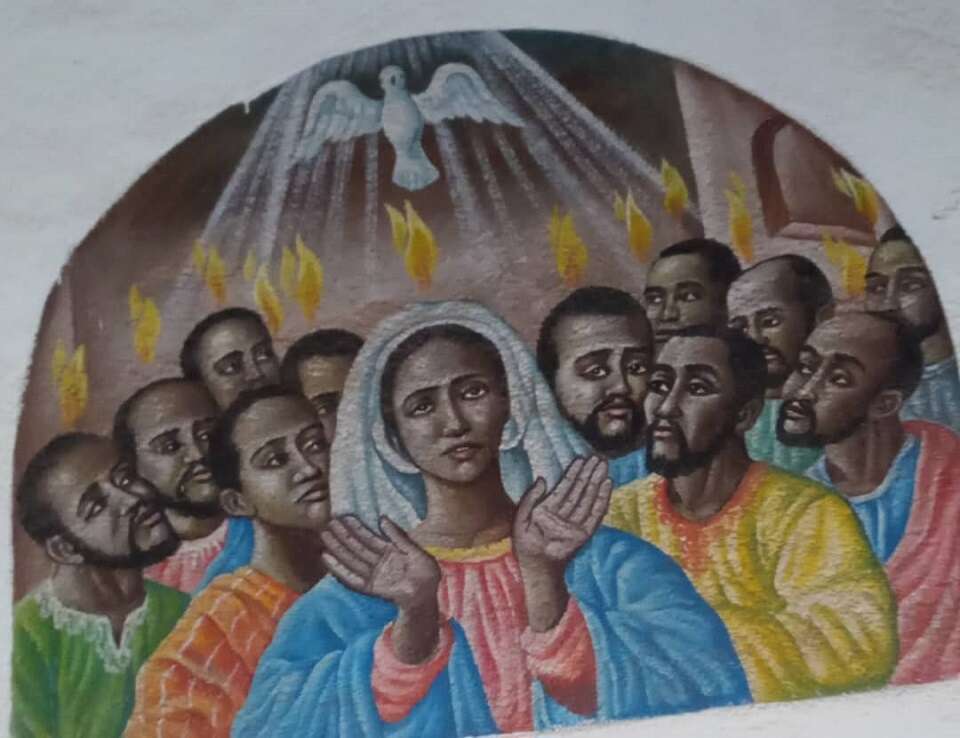
We celebrate the great day of Pentecost when Christ filled his Church with the power of his spirit. The readings are: Acts 2:1-11; Ps 103; Gal 5:16-25; Jn 15: 26-27; 16: 12-15.
During the last supper with his disciples, Jesus promised the Holy Spirit to his disciples: “when the Advocate comes, whom I shall send to you from the Father, the Spirit of truth who issues from the Father, he will be my witness” as we read in the Gospel of this Sunday.
This happened at Pentecost or feast of Weeks so called because it was celebrated seven weeks or fifty days after Passover. It was a pilgrimage feast when pious Jews came from their homes to the Temple or central shrine in Jerusalem. Different from other pilgrimages, this happened after Jesus’ death and resurrection. His Galilean disciples and his family came to Jerusalem and while they were there, the presence of the Spirit was charismatically manifested as they began to speak in tongues.
The way saint Luke narrates Pentecost in the Acts of Apostles reminds us the gift of the Law at Sinai, the prophet Joel and the Tower of Babel.
“On the morning of the third day there was thunder and lightning, a thick cloud appeared on the mountain, and a very loud trumpet blast was heard. All the people in the camp trembled with fear. Moses led them out of the camp to meet God, and they stood at the foot of the mountain. The whole of Mount Sinai was covered with smoke, because de Lord had come down on it in fire…. Moses spoke, and God answered him with thunder” (Ex 19, 16-19). If God gave the Law to his people at the mountain of Sinai, at Pentecost God gives his Spirit to his people.
Likewise, the day prophesied by the prophet Joel (Jl 3,1), is fulfilled on this day of Pentecost. Then about the Tower of Babel (Gn 11: 1-9), the history can be summarised like this: the people were speaking the same language. They decided to build a tower. But God dispersed them and no one could listen to another. So as to mean that people should not get the same thought, the unique thought, unique project because unity is not uniformity. That’s why we can say that at Babel people learnt diversity while at the day of Pentecost they learnt unity in diversity.
For our Church, since we are preparing the second season of the synod, we have to revise the Church as communion where everyone can speak in his own language, he can freely give his own opinion. Since her beginning (at Pentecost), the church is called to live in unity, but not in uniformity. It is not a church where the priest is seen as the chief of the lay people, but all together living in communion.
Saint Paul, in the second reading, helps us to know how we can or not be led by the Spirit. The Spirit brings: love, joy, peace, patience, kindness, goodness, trustfulness, gentleness and self-control. Whereas the opposite of the Spirit is: fornication, gross indecency and sexual irresponsibility, idolatry and sorcery, feuds and wrangling, jealousy, bad temper and quarrels, disagreements, factions, envy, drunkenness, orgies and similar things.
Let us be directed by the Spirit.
We celebrate the great day of Pentecost when Christ filled his Church with the power of his spirit. The readings are: Acts 2:1-11; Ps 103; Gal 5:16-25; Jn 15: 26-27; 16: 12-15.
During the last supper with his disciples, Jesus promised the Holy Spirit to his disciples: “when the Advocate comes, whom I shall send to you from the Father, the Spirit of truth who issues from the Father, he will be my witness” as we read in the Gospel of this Sunday.
This happened at Pentecost or feast of Weeks so called because it was celebrated seven weeks or fifty days after Passover. It was a pilgrimage feast when pious Jews came from their homes to the Temple or central shrine in Jerusalem. Different from other pilgrimages, this happened after Jesus’ death and resurrection. His Galilean disciples and his family came to Jerusalem and while they were there, the presence of the Spirit was charismatically manifested as they began to speak in tongues.
The way saint Luke narrates Pentecost in the Acts of Apostles reminds us the gift of the Law at Sinai, the prophet Joel and the Tower of Babel.
“On the morning of the third day there was thunder and lightning, a thick cloud appeared on the mountain, and a very loud trumpet blast was heard. All the people in the camp trembled with fear. Moses led them out of the camp to meet God, and they stood at the foot of the mountain. The whole of Mount Sinai was covered with smoke, because de Lord had come down on it in fire…. Moses spoke, and God answered him with thunder” (Ex 19, 16-19). If God gave the Law to his people at the mountain of Sinai, at Pentecost God gives his Spirit to his people.
Likewise, the day prophesied by the prophet Joel (Jl 3,1), is fulfilled on this day of Pentecost. Then about the Tower of Babel (Gn 11: 1-9), the history can be summarised like this: the people were speaking the same language. They decided to build a tower. But God dispersed them and no one could listen to another. So as to mean that people should not get the same thought, the unique thought, unique project because unity is not uniformity. That’s why we can say that at Babel people learnt diversity while at the day of Pentecost they learnt unity in diversity.
For our Church, since we are preparing the second season of the synod, we have to revise the Church as communion where everyone can speak in his own language, he can freely give his own opinion. Since her beginning (at Pentecost), the church is called to live in unity, but not in uniformity. It is not a church where the priest is seen as the chief of the lay people, but all together living in communion.
Saint Paul, in the second reading, helps us to know how we can or not be led by the Spirit. The Spirit brings: love, joy, peace, patience, kindness, goodness, trustfulness, gentleness and self-control. Whereas the opposite of the Spirit is: fornication, gross indecency and sexual irresponsibility, idolatry and sorcery, feuds and wrangling, jealousy, bad temper and quarrels, disagreements, factions, envy, drunkenness, orgies and similar things.
Let us be directed by the Spirit.